2025 | Volume 26 | Issue 3
OPUS (no.93)
Author: Associate Professor Felix Behan AM
As Dr Tom Robbins observed to me recently, rules make you think before you break them and with experience developing from years of surgery, one can write their own set of rules, reflecting such experiences.
Breaking rules, deviating from the established norms often leads to unexpected surgical successes.
Musically, even Dmitri Shostakovich was ostracised by Stalin because of his modern musical compositional bent, breaking conventions. His Reilley Ace of Spies was a melodic triumph defying conventions and yet found favour. However, to survive, Shostakovich restricted his creativity until the tyrant died. As an interesting aside, Stalin’s favourite piece of music was the romantic Mozart’s piano Concerto No. 21, still spinning on the turntable when he died.
Helen Keller once said, "The heresy of one age becomes the orthodoxy of the next," which has strong surgical implications. New techniques evolve and are eventually adopted. I unintentionally broke rules with new techniques looking for simpler alternatives over the span of my surgical career.
Oscar Wilde cleverly synopsised experience in his own phraseology: ‘Experience is simply the name we give our mistakes.’
During surgery, over the years, we are merely proceduralists. And new ideas emerge. We manage to do something that can be improved technically, it becomes a new idea, often with sound clinical applications.
My first broken rule before publishing a dislocated hip joint technique was a simple way of reducing a dislocated hip joint. I used my shoulder as a fulcrum point to lever the joint back into alignment with the patient lying prone on the operating table. As in cooking, the simplest way is always the best, and I have now become a frustrated chef. And this ingrained tendency of reverting to simplicity is mirrored throughout my surgical career, and fortunately my observational inclinations have been the basis of my success.
General Douglas MacArthur said, “Rules were meant to be broken” following his defeat in the Philippines in WWII and he parted saying, “I will return”.
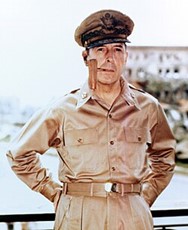
General Douglas MacArthur
It made me recap those surgical procedures in my career where my thinking, when looked at critically, broke rules in the pursuit of excellence.
Case 1: This was the genesis when I first began to question surgical regulations during my London days when I was a registrar at St George’s Hospital. An IRA sympathiser was shot in the kneecap by a policeman defending a member of the Royal family. He needed a cross-leg flap for the 5cm defect but cross-leg flaps had their own limitations, often failing. I lined the flap with fascia from the calf to substantiate the repair, leading me to the fasciocutaneous island flap concept, eventually leading to the Keystone. It worked by simply breaking the rules and not have a flap based on skin and fat.
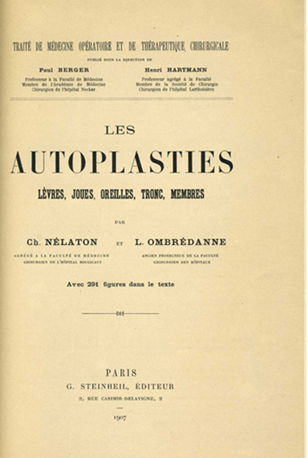
The original Ombredanne textbook by the
French surgeon plagiarised
by Harold Gillies, I suspect.
I bought this book in Paris at the Alain Brieux antique
bookstore
Case 2: I have already broached the subject of Leeches and venous drainage in solving the problem of composite grafts. How? Fenestrations are the solution facilitating venous drainage to ensure safe healing.
Case 3: This concerned a person who during an alcohol-fuelled altercation had half his nose, around the alar rim, bitten off. I simply took a wedge from his other ear, sewed it in meticulously and fenestrated it. Again, success came my way and published in my textbook Surgical Tips and Skills with Elsevier in the 90s.
Case 4: At the Western Hospital in Melbourne, we would do up to four flexor tendons a week. The adhesions in the tendon sheath became the bane of our lives, despite the hand therapy input. We then adopted the Kleinert technique of passive mobilisation to avoid this impediment of adhesions. Harold E Kleinert from Louisville, Kentucky—even in his 80s—would come in and supervise Trainees, as I did throughout my surgical career at the Western Hospital for more than 40 years—even on Christmas Day.
I modified the technical tendon repair using the ends of the Kessler suture and threading this up a spinal needle in the core of the distal tendon and tied it over a button of the subungual tip. Gill McKinstry, my hand therapist, was full of praise and wonderment, but others who had not seen me do it were somewhat critical about its application. Yet, I presented this at the Hand Surgery Meeting in Cairns in the mid-90s and should be on record somewhere.
The next bit of luck was in ring avulsion surgery when a patient came to the Lorne Hospital before I transferred him to the Western Hospital to do the procedure. I found an island of epidermis with its intact venous drainage lines visible and moved this from the adjacent middle finger to the ring finger, avoiding micro-venous grafts. So, we had a flap to cover the defect of the replacement with its own venous drainage intact. Years later, this case was published in the British Journal of Hand Surgery1 with Patricia Terrill and Andrew Cavallo. Like many such insights, it’s now buried in the archives of plastic surgery libraries—technically retrievable, but all too often forgotten. It's worth bringing it back to light. Yet again, we broke another rule with a fortuitous outcome and the patient regained full functional recovery delivering bread at Lorne (a funny place to do postoperative review).
As time passed the Keystone concept emerged as my source of original thinking. It was an arc flap, based on the dermatomal mark outs, fascial lined and is the basis of surgical loco-regional reconstructions resurrected and now accepted internationally, even being invited to present at a recent International Microsurgery Club webinar. Dr Rollin Daniel from California, who did the first microsurgical procedure in 1973 with Professor Ian Taylor, congratulated me on the intuitive simplicity of the idea in a recent email and has become a firm advocate.
A few more MacArthur recollections do not go astray on this concept of breaking rules:
‘You are remembered for the rules you break’.
‘There is no security on this earth, only opportunity’.
‘Old soldiers never die they just fade away’—like plastic surgeons (like me).
‘Never enter a procedure or war without the will to win’.
‘We are not retreating we are just advancing in another direction’.
‘A true leader has the confidence to stand alone, the courage to make tough decisions, and the compassion to listen to the needs of others.’
One can reassess these words of wisdom in a surgical domain.
So yes, I have broken rules in plastic surgery. The Keystone allows me to close flaps under tension and fenestrations have facilitated the success of composite grafts.
1. Behan, F.C., Cavallo, A.V., Terrill, P.
Ring avulsion injuries managed with homodigital and heterodigital venous island conduit (VIC) flaps. J Hand Surg. 1998; 23B:465-471