2025 | Volume 26 | Issue 6
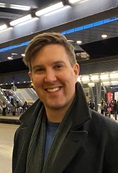
Dr Charlie Coventry, a General Surgery Trainee from South Australia, was awarded the RACS 2024 Margorie Hooper Scholarship to complete a six-month Trauma Surgery Fellowship at the Royal London Hospital. With more than 3000 major trauma cases annually, the hospital offered hands-on experience across the spectrum of trauma care, from roadside resuscitation to emergency surgery. For Dr Coventry, the Fellowship was an opportunity to bring world-class trauma skills back to South Australia, where trauma remains the leading cause of death in people under 44.
He says the humanitarian aspect of medicine drew him toward trauma early on: “It was just something that always interested me.”
Training at London’s busiest trauma centre
Dr Coventry chose the Royal London Hospital, London’s busiest, for exposure to penetrating trauma, particularly knife-related injuries. “This hospital has a high volume of such cases and extensive expertise in managing them.” Trauma surgeons there also manage vascular and cardiothoracic trauma, in the absence of onsite cardiothoracic services—experience highly relevant to major trauma practice.
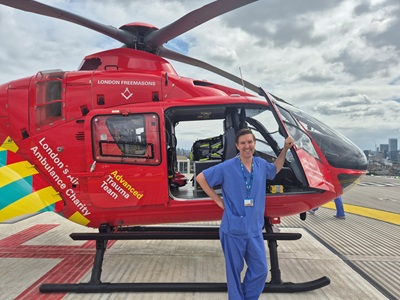
The London Air Ambulance
The London Air Ambulance, based at the Royal London, is one of the world’s leading pre-hospital services. Dr Coventry joined a ride-along during a busy shift. “I worked alongside highly experienced paramedics and pre-hospital doctors and saw how they respond to traumatic cardiac arrest and critically injured patients in challenging environments. It was an excellent experience.”
Managing critically injured patients in Australia
Penetrating trauma is less common in South Australia, but when cases occur, they are high-stress and rapidly evolving.
He says that while there is increase in non-operative management, surgery remains life saving for many severely injured patients. His time in London strengthened the operative skills and experience required for complex trauma cases and managing multiple casualties simultaneously.
Mass casualty preparedness
For Dr Coventry, a key focus post London is mass-casualty planning. “Luckily, mass-casualty incidents remain uncommon in South Australia, but they can still occur.” Learning from a centre that has unfortunately faced such events repeatedly was invaluable. Dr Coventry emphasises ensuring strong surgical preparedness and widespread understanding of mass-casualty plans.
Professional impact
Speaking of the scholarship, he says, "I encourage people with specific goals in their surgical career, but are short of funds, to apply, because it's been a life-changing experience for me, and incredibly fulfilling.”
He recently instructed at the DSTC course in Melbourne, which helps prepare surgeons, anaesthetists and perioperative nurses for major trauma scenarios. He finds it useful to bring learnings from overseas Fellowships back to your own health system and assess what can be improved and what works. “There are things we have in South Australia that work extremely well, and that we should be proud of, and continue to protect and foster.”
Work–life balance
Speaking of his routine, he says, "Trauma surgery is 95 per cent run-of-the-mill and five per cent pure panic." His twin daughters keep him grounded, and values time with his family. Running, exercise and walks with his Golden Retriever help maintain balance. He also serves as an Air Force Reservist, enjoying insight into defence systems and medicine. The support of his wife and family keep him going.
He recommends When Breath Becomes Air to junior doctors for its perspective on balance and cites Richard Flanagan's Question 7 among recent favourites.
Broadening horizons
The RACS Margorie Hooper Scholarship opened opportunities that would otherwise be out of reach. Now back in Australia, Dr Coventry is focused on strengthening trauma care and supporting Trainees to build operative confidence. His experience shows how targeted international training can enhance not only one surgeon’s career, but also the broader surgical community and the patients it serves.