2025 | Volume 26 | Issue 6
I seem to be taking a leaf out of the Agatha Christie style of writing and repeating stories (like Poirot) and this is the umpteenth time I have written about penicillin. Why? Some pearls surfaced recently on the Antiques Roadshow that need the light of day.
I am not a novelist but a storyteller. Even Professor Don Marshall, AM described my writings as a little Behanesque as I speak differently. He was obviously referring to the writings of Damon Runyon known for his yarns of New York City gangsters. I still recall seeing Guys and Dolls when Marlon Brando and Frank Sinatra took a young Salvation Army postulant called Sarah (played by Jean Simmons) down to the Caribbean for pina coladas and no doubt enjoying Arthur Benjamin’s Jamaican Rumba.
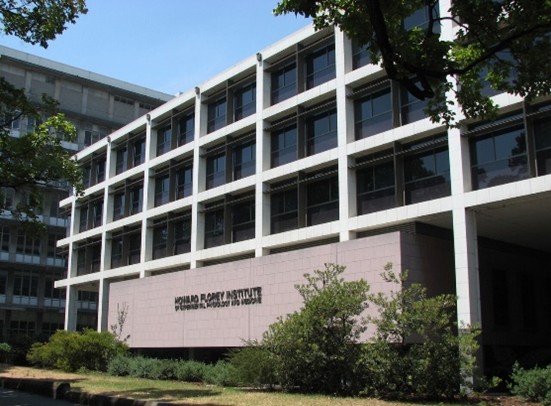
It was the former Vice Chancellor of Melbourne University, Glyn Davis, AC, who pointed to The Florey one day and said, “Why don’t you write something about that?” as he enjoys the snippets I put together for Surgical News on email. So, here it is Glyn, a little belated—thanks for the coffee.
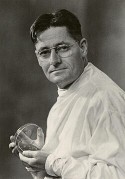
The Florey Institute, named after Professor Sir Howard Edward Florey, OM, of penicillin fame, became the Australian medical research institute of Neuroscience and Mental Health. Florey, an Australian pharmacologist and pathologist and Rhodes scholar from Adelaide, shared the Nobel Prize in Physiology or Medicine in 1945 with Ernst Chain and Sir Alexander Fleming in their role of developing penicillin. Chain wanted to put a patent on it, but Florey insisted it was for the good of humanity and not commercial gain.
Although Fleming received the initial credit for his observational discovery of penicillin at St Mary’s Hospital in 1928, it was Florey and his Oxford University team who made it into a useful medical remedy. Their developing techniques for growing the mould and purifying the extract and converting it to an injectable drug, eventually saved millions of lives in World War II.
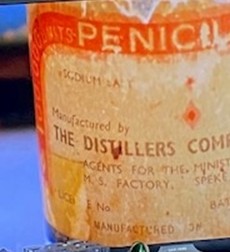
The Anitques Roadshow recently featured a sample bottle of penicillin from The Distillers Company salvaged from the rubbish (imaged). The new manager’s attitude is summarised by his reprimand to one of the young employees who retained the bottle saying, “This is a commercial drug factory development site son, not a museum” and a quote of value came in at £30,000.
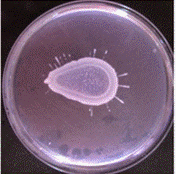
Thus, learning from history is an excellent teaching tool and as Leonardo da Vinci said: “Observation is the best form of knowledge”. And so, it was Fleming’s observational finding of the death of the staphylococcal growth on the Petrie dish (imaged), which was the basis for this success.
Fleming found the penicillin mould was the aetiological cause and the death knell for staphylococcus growth. Yet Florey produced the serum exudate—the basis for treatment. Why is it called penicillin? As it has the appearance of hairs on a painter’s brush, reflecting its Latin origin.
Today, I want to share a memorable experience from early in my career. At the time, I was working at the Royal Brisbane Hospital when the Health Department asked me to fill in as a locum. The role took me to Julia Creek in North Queensland, to the medical practice of the late Professor Errol Maguire. While I was there, something extraordinary happened. I was asked to perform a post-mortem on an elderly person who had passed away. The body had been lying in a bore drain for six days, in scorching temperatures above 30°C. It was a challenging situation. We carried out the post-mortem in the local hospital, with guidance from the Health Department and support from the hospital staff. It’s an experience I’ll never forget.
I cut my finger during the procedure—an invitation for septicaemia. My father advised me to inject my buttock with penicillin into the upper outer quadrant, avoiding the sciatic nerve and I lived to tell the tale, no doubt thanks to penicillin.
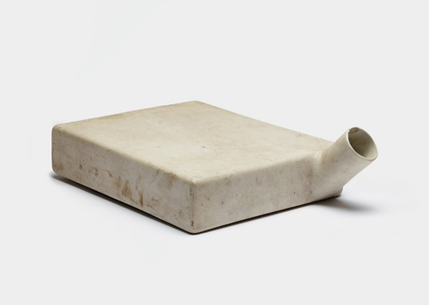
Another bonus from the Antiques Roadshow was the Heatley fermentation porcelain vase (imaged). This was used in the initial manufacturing to minimise absorption, helping to stabilise the penicillin solution before it became commercial under Merck, Sharp & Dohme in the US.
Norman Heatley accompanied Florey to America to seek commercial production as Winston Churchill could only spare £50 for this clinical idea—he needed more spitfires.
None would have dreamed about this additional detail in the penicillin story if not for the Antiques Roadshow, valuing it also at £30,000.
Florey flew to Lisbon with the penicillin mould sewn into his overcoat, should he be captured by the Germans. Chain missed out on receiving any patent benefits as these went to the Americans who could not walk past a dollar, and this patent application delayed commercial production. Even the UK government had to pay royalties for their own discovery.