2025 | Volume 26 | Issue 6
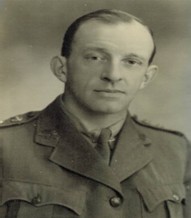
In the RACS heritage collection, some items are too large to display easily but are very significant to the collection. One of these is a framed British flag used by prisoners of war (POW) in World War II to bury dead and was respected by the Germans.
It originally belonged to Major Brooke Moore who asked Padre T Oakley to care for it. When it came to RACS, Daryl Lindsay gave advice about its display and care.
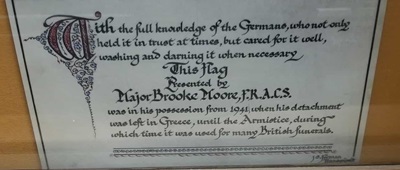
The plaque on the frame of the flag reads: ... This Flag Presented By Major Brooke Moore, F.R.A.C.S. Was In His Possession From 1941 When His Detachment Was Left In Greece Until The Armistice During Which Time It Was Used For Many Funerals.
In 1940 Dr Brooke Moore enlisted and served with distinction as a specialist surgeon with the rank of major in the 2/5th Australian General Field Hospital (AGH). About half of 2/5 AGH's staff were evacuated from Greece before it fell to the Germans but the remainder, including Dr Moore, were captured on 27 April 1941. The hospital was allowed to continue operating from various locations in Athens, where he performed surgery on many Australian, New Zealand and British battle casualties. In December 1941, its staff and patients were dispersed to various POW camps in Germany.
Dr Moore ended up in Stalag 383 at Hohenfels, near Nuremburg, where he formed a branch of the St. John Ambulance Brigade. He became known for standing up to the Germans, demanding the best possible treatment for his patients. As a result of his wartime service, he was mentioned in several books written about the evacuation and the treatment of prisoners.
The following clipping from the London Sunday Express was forwarded to The National Advocate by WO K. A. Nichols of 85 Piper Street, Bathurst, who was serving with the RAAF in England:
Street, Bathurst, who was serving with the RAAF in England:
Dr Brook Moore
In German Prison Camp.
This is an account of probably the first flag of the United Nations to fly unmolested in Germany during this war. I made a Union Jack from a New Zealand parcel wrapper, it was hoisted at midnight, December 31, 1943, on to the roof of one of the three escapees huts in Stalag 383, Bavaria.
The ceremony was the climax to a party to welcome the New Year with its promise of landing in France. Present were the 14 occupants of the huts all men with several attempted escapes to their credit, and some of their friends. At midnight the party paraded outside the hut and the Union Jack was hoisted. It flew… until noon, January 1, 1944, when it was taken down and shared between the members of the hut. During its reign it was saluted by two officers.
Major Brooke Moore of the Australian Medical Corps, and one of the camp security officers.
Hauptmann Katschorek.' Henry Vies Sugijit, ex-L.Sgt, 5 Ridg. BEF. 15 Wold Road. Hull." from the National Advocate, Bathurst, NSW 1st of September 1945. https://www.westernadvocate.com.au/story/7375928/yesterday-today-bathurst-doctor-stood-up-to-the-germans/
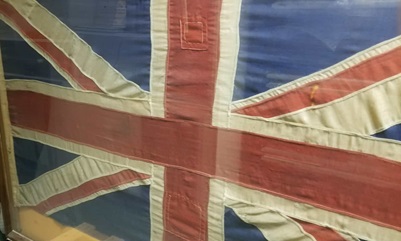
It is noted in RACS Archive Series 203, that on the 1 June 1949, Dr Brooke Moore of Bathurst, NSW presented a Union Jack, which had been in the possession of his unit, the fifth Australian General Hospital. This flag was with the unit when a detachment, including Moore himself, was left in Greece in 1941.
The flag was kept by his unit with the full knowledge of the Germans and used for at least 73 British funerals. Dr Brooke Moore was allowed to carry the flag to Poland and either kept it in his possession or had it held in Trust for him by the Germans, in which case, they always gave him a receipt.
On his repatriation, the flag was left in the keeping of Padre T. Oakley, C F who was allowed to keep it until the Armistice and brought it back to Dr Brooke Moore in Australia. When the Germans had charge of the flag, they not only preserved it but even darned and washed it.
Advice to the most suitable method of displaying it was given by Daryl Lindsay, Director of the National Gallery of Victoria. Fay McClure made a suitable staff with turned brass mountings and the flag hung upstairs near the RACS library, together with a descriptive plaque.
We are honoured to have such a unique item in the RACS collection.