2025 | Volume 26 | Issue 6
Author: Dr Peter F Burke FRCS (Eng) FRACS DHMSA
Not once, but twice, surgeons have been elected as the Lord Mayor of the City of London.
To be elected is no easy matter, requiring a series of time-honoured steps which do warrant explanation. The City of London lies in a small area, which is sometimes called the ‘Square Mile’, because it is about one mile long by one mile wide. Some of the Roman city wall still survives, the names Moorgate, Aldgate and Bishopsgate indicating where there were entrances.
The City is divided into 25 wards, each of which has an Alderman elected by the registered voters of that ward, with a six year appointment, and two or more, Common Councillors who serve four year terms.
The 25 aldermen are members of the Court of Aldermen, first formed in 1385, from which future sheriffs and Lord Mayors of the City of London are selected. Two sheriffs are elected in September each year and play an important role in supporting the Mayoralty. They promote links between the City Corporation and the judiciary at the Old Bailey as the Lord Mayor is the chief justice of the City of London.
The ‘Senior Alderman below the Chair’ is a ceremonial role within the Court of Aldermen, ranking below the Lord Mayor, but indicative of a potential position as Lord Mayor-elect. Elected annually the Lord Mayor is the head of the City of London Corporation; the official mayoral residence is Mansion House; and within the City only the Sovereign has precedence over the Lord Mayor.
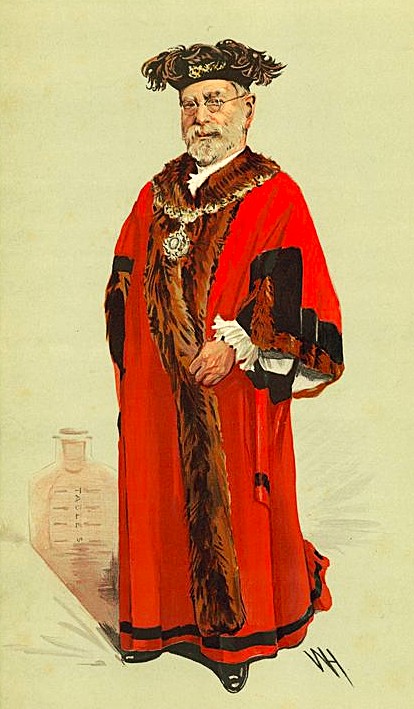
Sir Thomas Boor Crosby, robed as Lord Mayor of The City of London. Vanity Fair magazine, 8 Nov 1911
Thomas Boor Crosby—the son of William Crosby, a Lincolnshire farmer, and Mary Boor—was apprenticed to a local surgeon and then studied at St Thomas’ Hospital, London. In May 1852 he became a Member of the Royal College of Surgeons(MRCS) and obtained the Licence of the Society of Apothecaries (LSA), the hallmarks of the typical general practitioner, colloquially known as ‘College and Hall’: he gained his FRCS in December 1860. At St Thomas’ Hospital he was appointed house surgeon and demonstrator of anatomy in the medical school, and in 1862 became MD (St Andrews).
After leaving St Thomas’ he joined an established firm of practitioners in Fenchurch Street EC, which remains a well-known thoroughfare in the City’s financial district. Subsequently, he moved to Finsbury, which borders the City of London in Islington, where he enjoyed a large practice.
Crosby’s interest in, and involvement with municipal affairs dated from 1877 when he was elected a Councillor of the City for the Langbourn Ward. In 1898 he was elected as Alderman for that ward, and in 1906-1907 appointed as one of the two City of London Sheriffs. Crosby being the Senior Alderman below the Chair in 1911, then progressed to the role of Lord Mayor of the City of London 1911-1912.
He was then 82 years of age: his election gave him the double distinction of being the first medical man to occupy the Civic Chair in the metropolis, and the oldest citizen to become the Lord Mayor of London. He was celebrated in the Vanity Fair magazine of 8 November 1911, his portrait in the trained scarlet aldermanic robe of Lord Mayor, captioned, ‘His Lordship of London, M.D.’
During his tenure, he once dined at the Royal College of Surgeons. Shortly before his resignation, Crosby hosted a large gathering at the Mansion House for members of the medical profession to meet the presidents of the Royal Colleges of Physicians and Surgeons—Sir Thomas Barlow and Sir Rickman Godlee.
The principal toast was given by the Mayor. He referred to his long connection with the medical profession and the efforts he made during his year of office to systematise and extend the use of special hospitals for teaching purposes. Among those present were Sir William Osler and Sir Clifford Allbutt, Regius Professors of Medicine in the Universities of Oxford and Cambridge respectively.
Thomas Crosby had entered upon the duties of the chief magistracy at a more advanced age than any of his predecessors and filled that position with dignity and success.
When a coal strike threatened a national disaster, he promptly arranged a conference of municipal authorities from all parts of the country at Mansion House, leading to the avoidance of a dangerous social situation. He also opened a fund for the relief of the widows and orphans of those who were lost in the Titanic disaster, and more than £450,000 was collected.
In his private life, Crosby was described as a shrewd, witty, kind, homely man and his success was attributed to the outcome of persistent habits of hard work and self-restraint. One obituary noted, ‘to the last he walked, spoke and thought like a young man’.
His public services were recognised by the grant of the honorary degrees of LLD from Dublin and St Andrews. He died aged 86, at his London home on April 7, 1916, after a brief illness.

Author and Sir John Chalstrey's portrait, Barber Surgeons' Hall, London 2009
Our second Lord Mayor was one whom I knew and worked with at Hackney Hospital, in the East End of London in 1977. John Leonard Chalstrey was one of the Barts consultant surgeons who worked there, and we formed a happy and tight knit team.
John specialised in oesophageal and gastric cancer surgery and became a founder member of the Society of Minimally Invasive General Surgeons. He was the first to establish an independent day case endoscopy unit in London.
I recall him as quietly spoken and seemingly shy, and as his RCS obituary states, he was: ‘always polite and courteous in his interactions with other hospital staff, irrespective of their position or seniority’.
During that year and the next I was heavily involved with the Society of Apothecaries of London, where I completed the diploma course in the History of Medicine. Sadly, I had no knowledge of John Chalstrey’s involvement with this livery company of the City of London Corporation.
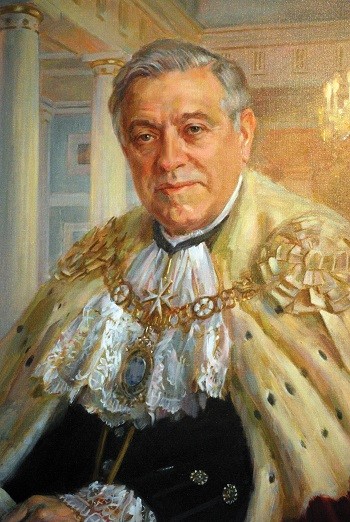
Sir John Chalstrey in state robes, Mansion House. Portrait by Australian artist, June Mendoza
Practising within the City of London he developed a profound interest in the workings of the City of London Corporation and its livery companies. He was elected as Alderman of Vintry Ward in 1984 and subsequently as one of the two City of London Sheriffs in 1993-1994. This enabled his election as the 668th Lord Mayor of London 1995-1996, following which he was knighted.
His obituary records that he was a member of the Worshipful Society of Apothecaries and its Master from 1994 to 1995: whilst Master Apothecary, the Society instituted the Diploma in the Medical Care of Catastrophes, and he was appointed as Surgeon-in-Chief to St John Ambulance.
He was also a member of the Worshipful Company of Barbers where he was Master from 1998- 1999.2 Chalstrey was the first Lord Mayor to have the Apothecaries as his mother livery company and was the second Fellow of the Royal College of Surgeons of England to be Lord Mayor.
His 1996 portrait by the Australian artist, June Mendoza, shows the mayoral attire for state occasions, such as when the monarch is present. The Lord Mayor is wearing a crimson velvet robe of state trimmed with an ermine cape and facings. It is tied with gold cordons, and dates from the reign of George IV.
Sir John Chalstrey died on 12 March 2020. He was 88.