2025 | Volume 26 | Issue 6
Author: Associate Professor Victor Kong, MD, PhD, ChM, MSc, DRCPSC, MRCS, FRACS, Trauma surgeon, Auckland City Hospital
Penetrating neck injuries (PNIs) can be challenging to manage. At the Chris Hani Baragwanath Academic Hospital (Bara), I encountered these injuries on a weekly, if not almost daily basis. Nowadays, the management of these injuries is more or less standardised (with slight variations from centre to centre), and the approach of selective conservatism is firmly established. The days of undertaking a mandatory neck exploration for all PNIs (which was usually undertaken by registrars, and often in the middle of the night) have faded into history. Indeed, those patients who require immediate explorations do not present as often as they once did, although these injuries are certainly still frequent in South Africa. Nevertheless, patients with PNIs and massive haemorrhaging who come into the resuscitation room belong to a particularly interesting group. These patients require surgery, and most textbooks recommend the application of direct pressure, as well as expediting the patient to the operating theatre for a formal neck exploration.

Another day in the office
When recalling my experiences with patients I have seen over the years, one thing for sure is: pressure alone is sometimes ineffective when dealing with these ‘junctional’ injuries. Once, a young man with such an injury was bleeding so heavily that blood was literally jetting through the stab wound, and applying ‘direct pressure’ with a gauze did nothing to help matters. The gauze came in a pack of around 20, and within a few seconds all had become bright red. It transpired that the patient had suffered a vertebral artery transection. The Foley’s catheter that I placed into the wound offered far better temporary control and was sufficient to buy enough time to get the patient into the operating theatre before he ensanguined.
Over the years, I have used a Foley’s catheter many times in different parts of the world. When I first began to do so, some of my colleagues looked astonished, even shocked and suspicious; some thought it was down-right insane. On more than one occasion when I asked for a Foley’s catheter, I was quietly asked why I wanted to catheterise the patient’s urethra, when the patient had an exsanguinating haemorrhage from the neck. But I can attest that the results speak for themselves and are now backed up by research I published based on my experiences in South Africa. This technique is the direct result of the ingenuity of South African trauma surgeons who were able to come up with pragmatic solutions as part of their approach towards dealing with these injuries.
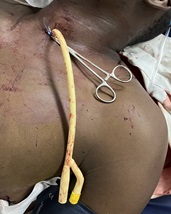
Using FCBT to manage a PNI -
a South African invention
Whenever I place a Foley’s catheter into a patient’s neck wound, I always ensure I take my time to demonstrate and explain what I am doing and why to the junior doctors and medical students. The application of its use in the temporary control of an actively bleeding neck wound was first reported by trauma surgeons at Bara in 1992. Subsequently, it was re-popularised by trauma surgeons at the Groote Schurr Hospital in Cape Town. Managing PNIs can be a surreal experience on many levels. At Bara, I was always aware of the privilege to be working in the very same hospital where towering figures of trauma surgery had pioneered different techniques, which have contributed much to trauma care. In this respect, I have carried on using ideas which were devised at Bara with great pride.