2026 | Volume 27 | Issue 1
.jpg?h=446&w=400&rev=78cfd501353d477e8ccb6ef97262010e&hash=F0F0A6D865C7D807CB9E5B52FE337AAC)
Dr David Hamilton (left) and Dr Richard Hamilton (right).
Five years ago, Dr David Wyndham Hamilton FRACS OAM put down his scalpel for the last time. He was 85.
“No one told me I was too old to work. I decided it was time,” he says.
With that decision, he quietly ended a career spanning six decades, countless surgeries, multiple awards—including an OAM and the Gold Medal Award from the Australian Association of Surgeons (which later merged with RACS)—hundreds of trained students and recognition across the industry bestowed on a select few.
In August 2025, Dr Hamilton received the highest honour for a South Australian surgeon, the Sir Henry Newland Medal, for his extraordinary contributions to surgery and decades of service to the South Australian community.
His remarkable career was inspired by another Adelaide surgeon.
The symphony of surgery
As a young man, Dr Hamilton watched his surgeon uncle, Ian Hamilton, operate. It was like watching a “symphony.”
“His technique was such that you didn’t think he was hurrying. Every procedure was like a symphony. It went on beautifully,” he says.
Inspired, he pursued medicine, graduating MBBS from Adelaide University before travelling to England to obtain his Fellowship of the Royal College of Surgeons (FRCS).
He gained invaluable experience as a registrar in the busy Walton Hospital in Liverpool under Keith Rawlinson, and later at Whipps Cross Hospital under Douglas Lang Stevenson, and under Alan Hunt at St Bartholomew’s in London.
“I was very, very lucky to be appointed under these surgeons, all of whom had outstanding reputations,” Dr Hamilton says.
He was also awarded a Master of Surgery from the University of Liverpool.
But Adelaide was always “home”, and in 1968 he returned with his wife, Janet, and their two daughters.
Here, his career took shape in ways that would influence generations of Trainees.
The surgeon’s surgeon
Dr Hamilton is considered one of the last “true general surgeons”.
While most surgeons specialised, he handled a broad range of procedures throughout his career.
He was among the first surgeons appointed to Modbury Hospital, serving from its opening in 1973 until his retirement in 2021.
Colleagues call him the “Surgeon’s Surgeon” as a tribute to his dedication to training hundreds of young doctors, guiding them through exams and celebrating their success. His commitment to Trainees was matched only by his commitment to his patients.
Surgeon to the poor
Dr Hamilton practised surgery with a guiding belief that illness should never become an expensive exercise.
Despite running his own private practice and operating theatre, he refused to charge gap fees. Accountants advised him to close a practice largely serving pensioners and patients with limited means.
“They can’t afford it,” was his stock standard response.
He lived modestly and measured success only by the care he delivered.
He was also never afraid to embrace change.
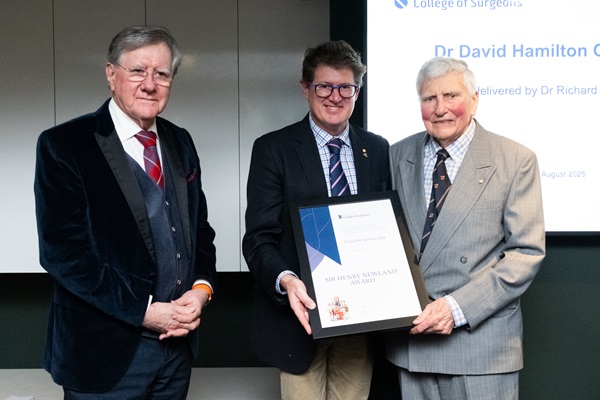
Left to right: Dr Richard Hamilton, Dr Bernard Carney and Dr David Hamilton.
Revolutionary change to surgery
Few changes tested surgeons more than the advent of laparoscopic surgery in the early 1990s.
While many retired rather than adapt, Dr Hamilton embraced the shift.
He mastered the new technique and watched as patients were able to heal quickly from procedures.
“I can remember a patient coming for an emergency appendectomy where we used laparoscopic surgery,” he says. “He went home the same day.”
Leaving a legacy
Dr Hamilton’s receipt of the Sir Henry Newland Medal was strongly supported by his surgical colleagues.
His contribution to surgery is surpassed only by his impact on his patients, his colleagues and the many Trainees fortunate enough to be mentored by him.
He has one piece of advice for upcoming surgeons: “You have to want to do it,” he says.
“It can be a tough life. You can be out in the middle of the night a lot.
“Many people today want lifestyle, and not to be tied to something like that.”