2026 | Volume 27 | Issue 1
 OP-XCVII
The genesis of this title is interesting and I hark back to David Livingstone’s time in Africa working for the London Missionary Society and his discovery of Victoria Falls (imaged), named accordingly. Later, a newspaper reporter from the New York Herald was after a scoop and went hunting for Livingstone and found him living with some local tribes, went up to him and shook his hands with the greeting—“Dr Livingstone I presume?” an expression now entrenched in historical writings.
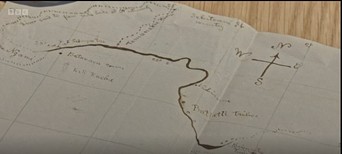
Livingstone’s original drawings of his discovery

An updated version of Victoria Falls
Now let me elaborate further on my own “Dr Livingstone, I presume” experience. I was in the waiting room of my local medical practitioner, Dr Meredith Lewis when a gentleman—a stranger to me—walked across the room and shook me by the hand and said, “You are Felix Behan, the designer of the Keystone flap”. I responded, “Bullseye sir, you’ve got me”. It transpired the gentleman in question was Dr Ian Hayes, a major colorectal surgeon at the Royal Melbourne Hospital who works a few months per year with Médecins Sans Frontières (MSF). He said the Keystone was an invaluable tool in surgical manoeuvres to expedite surgical clearances for the injured from Haiti to Congo.
He later reviewed my article and added, “When I was on an MSF training course in Germany, a Yemeni surgeon instructed me on how to do the Keystone flap. When I said I was from Australia—he knew you came from Melbourne—he asked me to thank you on behalf of the Yemeni surgical community if I ever met you. He felt the Keystone flap had been a major boon to war surgery in Yemen.”
We got talking about how I came upon this flap idea. I also mentioned how Martin Coady, curator of the BAPRAS Collection in London has my initial Keystone research in their archives. Martin contacted me recently about his social meeting with another person—a military surgeon from Ukraine who was extolling the technical virtues of the Keystone flap for its speed in surgical execution.
My weeks are peppered with email correspondence with surgeons around the world, from the Livingstone episode to the BAPRAS vignette quoting the surgical military commander from the Ukraine over to North Macedonia, then onward to China and South America.
World experts Dr Geoffrey Hallock from Pennsylvania and Dr Rollin Daniel from California have witnessed the slow acceptance of the Keystone (my leitmotif in my textbooks and presentations around the world) before they adopted it themselves in clinical practice. Helen Keller captured this slow surgical metamorphosis perfectly in her observation: “Today’s heresy is tomorrow’s orthodoxy”. The Keystone breaks rules in reconstructive surgery entrenched in history. In summary, we have a fascial base with an embryological compass of arteries, nerves, veins and lymphatics randomly placed developing this empirically based technique.
The Keystone principle was even on the world stage last year through a webinar, a first for me, to the International Microsurgery Club (IMC) which led to multiple email enquiries the following day from Rwanda to Bangladesh seeking clinical advice on using a Keystone to solve a surgical problem with my email response. The Keystone flap continues to prove its adaptive versatility, and operative videos demonstrating the technique are available in the Springer Nature textbook on orthopaedic management. These webinars are an excellent introduction and will become the basis of future world teaching in surgery.
Yes, you can buy information but you cannot buy experience. The guidance we provide to surgeons worldwide through email should form a key part of the College’s ongoing teaching.
This leads me to recall Leonardo da Vinci’s famous statement—“I am a disciple of experience”.
Yes, I broke the rules—with justification—because of that sympathectomy effect of the Keystone and expeditious healing, creating a state of hypervascularity with its Red Dot Sign and vascular flare.
These incidental emails from the four points of the compass are somewhat rewarding, especially given how few local enquiries I receive about the technique. The Keystone continues to surface around the world—from Rwanda to the frontlines of Ukraine, and even Haiti thanks to Dr Ian Hayes—when I was able to offer surgical guidance to colleagues somewhat disadvantaged in the trauma and war zones. One tends to remember these items in one’s surgical career, displacing the dollar, which now has become a strong focus.
One can appreciate the world needs help and I offer my email services to anyone to facilitate a surgical solution to a problem with the simplicity of the Keystone.
The initial reluctance to use the Keystone locally is slowly changing and I have heard a major case at the Royal Melbourne Hospital was done recently with a Keystone. Someone also said the Keystone allows them to get home in time to have dinner with the children.
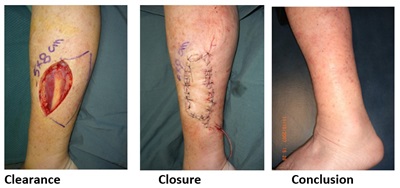
Keystone images from Springer Nature textbook on melanoma management
(Redacted by Dr Ian Hayes, confirming his verbal acknowledgements when we subsequently had coffee together)