2026 | Volume 27 | Issue 1
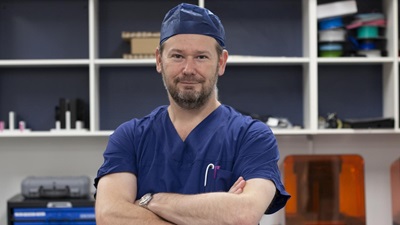
Professor Jonathan Clark, FRACS, AM is a world-renowned head and neck surgeon pioneering reconstructive innovation. As the 2024 John Loewenthal Project Grant recipient—one of the Royal Australasian College of Surgeons' highest value research awards—he leads a transformative shift in post-cancer recovery.
His landmark project, Rebuilding Lives After Head and Neck Cancer, addresses predictable reconstructive surgery outcomes. Traditional surgery relies heavily on surgeon expertise, often leaving patients with functional and aesthetic challenges. Virtual Surgical Planning (VSP) and 3D printing mitigate that risk. However, commercial suppliers prove prohibitively expensive. Professor Clark integrates VSP and 3D printing directly into hospital settings. This enhances pre-operative preparation while reducing financial burdens.
Speaking of the Fellowship, Professor Clark says, "The funding has been very helpful for progressing our research on transforming jaw reconstruction surgical planning. The Fellowship enables progress that would otherwise be impossible."
Integrating 3D printing into medical practice
Professor Clark focuses on ensuring "consistent and precise results that deliver outcomes patients deserve and need”. He says integration challenges include quality control requirements and regulatory compliance. Early free 3D planning software was relatively inexpensive but could not reproduce commercial quality. Adding Quality Management Systems enables Therapeutic Goods Administration (TGA) compliance. They are the first in Australia to achieve this under the new TGA regulations. However, costs remain higher than hoped, due to complexities in achieving safe, reproducible results.
The hospital-based manufacturing model offers advantages including innovation, meeting clinician needs, and avoiding supply chain issues. Professor Clark emphasised that “both point-of-care providers and commercial suppliers create a healthy healthcare system in Australia”.
From art to science
Professor Clark explains how 3D printing helps surgeons achieve results impossible with traditional techniques. “Before, reconstructive surgery was more art than science. We relied on clinical acumen and experience to make intraoperative decisions. However, I realised reconstructive surgery could be done better. VSP enables planning to much greater detail. It incorporates other disciplines into decision-making before entering the operating room. We achieve accuracy and precision impossible with traditional freehand operations.”
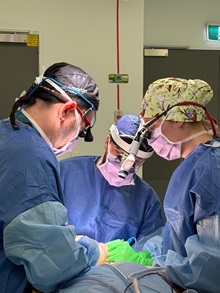
Three groups directly participate in surgery: the ablative surgeon removes tumours, the reconstructive surgeon harvests and positions bone grafts, and the prosthodontist advises on dental implant positioning. "Virtual surgical planning brings all three together in a virtual environment. We plan surgery together, examine potential outcomes, and determine optimal approaches. This forces interdisciplinary communication in every single case. We often make changes based on these discussions," he says.
VSP also enhances training. Since surgeons often operate in cavities and difficult locations, Trainees cannot always see procedures. “With VSP, everything appears on screen. Everyone sees the plan exactly. When we do point-of-care virtual surgical planning, we 3D print models. Trainees bend reconstruction plates to those models in controlled environments without operating room time pressures.”
Revolutionising patient outcomes
VSP helps patients understand procedure invasiveness and prepares them for inevitable life changes. “With traditional jaw reconstruction without VSP, we cut jaw bone for tumour removal. We harvested bone from the fibula to reconstruct. We used expertise to decide bone positioning. Good outcomes meant proper bone alignment and jaw contour. However, we could almost never position bone correctly for dental rehabilitation.
“Now, we do occlusal-based reconstruction. We position dental implants first in appropriate locations, then position bone around implants. This reverse-planning process begins with the goal: to reconstruct patients so their natural teeth align properly and facial contour is excellent. We then dentally rehabilitate them so they can smile, chew, and eat. As a result, they maintain nutrition and have face-to-face employment with confidence.”
Professor Clark's team developed the world's largest patient-reported outcomes repository. It includes more than 1000 patient surveys covering functional, psychosocial, and health economic effects. Findings show immediate dental implants, virtual surgical planning, and dental rehabilitation improve outcomes. Patients never fully recover to pre-condition status, especially after cancer surgery, due to radiotherapy and recurrences.
Functional and economic health
The team now focuses on health economic aspects to demonstrate surgery value to policymakers. They track patient outcomes and quality-of-life measures. Complications significantly increase surgery costs and negatively impact quality of life.
Professor Clark says, "Reconstructive surgery's artistic side attracted me. But I want a legacy that changes that. We need to move from personal judgement and expert opinion to science-based, evidence-based work. That is the best way to truly rebuild lives for our patients."
Curious? Are you keen to contribute to the development of research, surgical practise and leadership in our local and global surgical communities?
Apply to RACS Scholarships and Grants Program: www.surgeons.org/scholarships
Applications open from 3 March – 14 April 2026