2026 | Volume 27 | Issue 2

Dr Pia Bernardi
Author: Dr Pia Bernardi (Colorectal surgeon, Member of ESSPWP)
Dr Matt Irwin (CSSANZ Trainee)
For general and colorectal surgeons, a significant proportion of our day to day work comprises EUAs—the humble examination of the anorectum to investigate and treat several common anorectal conditions. These include perianal abscesses, haemorrhoids, fistulas, fissures and skin tags. We constantly remind junior staff that “this is not a sterile procedure” (or at least I do!). Yet, in many hospitals, the area is routinely draped and standard equipment opened, whether or not it is used.
Recently, CSSANZ Trainee Dr Matt Irwin presented his study at the 2025 Tripartite Meeting in Paris. The study examined per case use of consumables for common anorectal procedures across public hospitals in NSW over a one year period (6000 cases) and extrapolated for the 20,000 cases performed across Australia each year.
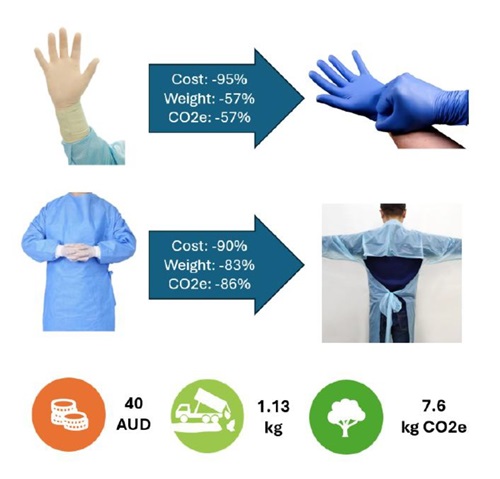
The results were surprising. Diathermy, smoke evacuators and suction devices were opened but unused in 50 per cent of cases. Targeted recycling of sterile consumables delivered negligible reductions in landfill and carbon emissions. This is due to multi-polymer construction that makes recycling impractical, with items often diverted to landfill or incineration despite entering recycling streams. Substitution with non-sterile alternatives reduced costs by $40 per case, with reductions of 1.13kg landfill and 7.6 kg CO₂e per case, equating to around $798,000 and 153 tonnes CO₂e annually across Australia. This is equivalent to emissions from over one million kilometres driven per year in an average Australian light car (149g/km).
Actions to achieve these results are simple:
• Ditch the Drapes. Instead, place one towel or absorbent underpad under the buttocks.
• Only open suction and diathermy on demand.
• For non-sterile PPE, use a single-use monopolymer gown or plastic gown and one pair of regular gloves.
• Place empty prep bottle in recycling bin.
This concept is applicable to other surgical specialties too. Similar cost and waste reduction benefits have been shown in adenotonsillectomy¹, cystoscopy² and simple hand surgery³.
The first principles of sustainability to ‘Rethink’ and ‘Reduce’ are highlighted in the idea of ‘Ditching the Drapes’. This is an easy change for us to adopt across our surgical practices to make a difference!
References
1. Gunda D, Bernardi M, Borschmann M. Implementing sustainable practices to reduce wastage and costs in adenotonsillectomy. ANZ J Surg. 2025;95(4):708–12. doi:10.1111/ans.19362
2. Melnyk AI, Mowers EE, Janmey I, Meyn LA, Woods N, Moalli P. Green cystoscopy: does minimizing the use of drapes increase infection rates? Urogynecology (Phila). 2024;31(11):1024–32. doi:10.1097/SPV.0000000000001602
3. Kodumuri P, Jesudason EP, Lees V. Reducing the carbon footprint in carpal tunnel surgery inside the operating room with a lean and green model: a comparative study. J Hand Surg Eur Vol. 2023;48(10):1022–9. doi:10.1177/17531934231176952