2026 | Volume 27 | Issue 2

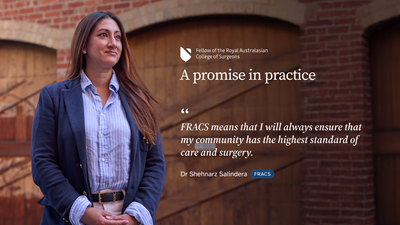
Two Fellows on what FRACS means, to them, their patients, and the communities they serve.
Dr Christine Lai is a South Australian breast and endocrine surgeon and RACS Fellow of 21 years. Dr Shehnarz Salindera is a general surgeon specialising in breast cancer care in regional New South Wales, a Fellow since 2016. We sat down with both to explore what Fellowship of RACS means in practice, as a standard, a commitment, and a promise to the patients and communities who depend on it.
Tell us a little about yourselves. Who are you outside the operating theatre?
Dr Lai: When I’m not working, photography is a real passion of mine, particularly landscape and nightscape photography. I recently returned from a trip to Norway chasing the Northern Lights, which was just spectacular.
Dr Salindera: I live at the beach because I love it. I spend time with family, and if I can get away, I’ll travel. My friends would probably describe me as passionate and someone you can give a task to if you need it solved.
What drew you to a career in surgery?
Dr Lai: I had this notion in medical school that surgery might be an interesting career, and I enjoyed every single rotation I was on. The person who had the biggest influence on me was Dr Melissa Bochner, a Fellow on my very first intern rotation in General Surgery. She was a great teacher, a great surgeon, and encouraged me to consider a career in surgery. Coincidentally, I ended up in her field—breast and endocrine surgery.
Dr Salindera: I always wanted to work in women’s health or breast cancer care. That started in high school, volunteering for Pink Ribbon campaigns and Cancer Council fundraisers. It aligned with my values—community, helping people—while still being grounded in science. Surgery connects you to the patient and their journey. You remove their cancer and most of them [patients] will do well. That’s a real privilege.
What does FRACS mean to you, and what promise does it represent?
Dr Lai: The Fellowship gives me a community of colleagues who have either trained me, I’ve trained with, or I’ve had the opportunity to train. But it’s more than a qualification. Being a FRACS surgeon means upholding competencies beyond medical and technical expertise—collaboration, teamwork, leadership, and health advocacy. We’re held accountable to those standards, and that’s what sets us apart. When I came out of training, I didn’t fully appreciate that, but over time I’ve realised the word ‘Fellowship’ truly means fellowship—the community we have around us, holding ourselves to a higher standard.
Dr Salindera: FRACS reflects the quality and standard of care I deliver to my community, but it also carries a deep personal meaning—the journey I went through, and what my family went through supporting me. To the community, it’s a promise that you have a rigorously trained surgeon in front of you who is continuing to meet that standard through ongoing education and professional development. It’s not something you did once. To maintain your FRACS you need to keep learning, keep being assessed. That continuity is the promise.
What principle do you never compromise on in your practice?
Dr Lai: I treat my patients the way I would expect myself or my family to be treated. That’s the most important thing to me as a surgeon and as a medical practitioner. I also hold myself accountable to auditing my results and reflecting on them, to make sure I’m delivering the best possible outcomes.
Dr Salindera: Patient safety, absolutely. In a rural setting there are often challenges. You may not have the ideal equipment or the trained staff around you. Ensuring consistent quality and safety every single time is critical.
What responsibility do you feel toward the next generation and what do you hope FRACS will always stand for?
Dr Lai: It’s really important that we teach and share our knowledge but also look beyond the training program, at junior doctors, students, even high school students, to encourage them to pursue surgery. We need to change the culture of our workplaces and advocate to improve health as a sector, so people want to stay. As Fellows, we need to continue striving for excellence, maintaining standards, auditing our results, pursuing research and innovation, so that FRACS remains a mark of the highest standard of care.
Dr Salindera: I see the next generation staying late, finishing cases, following patients through. They’re trying their absolute hardest to reach the standard, and we owe it to them to make sure that standard still means something. FRACS means I will always fight to ensure my community has the highest standard of surgical care, and fight for the services to deliver it. That’s the promise.
For nearly a century, FRACS has stood for something more than a post-nominal. It is a shared standard. A mark of trust. A promise to patients, peers and the profession that a surgeon has met the highest bar of training, assessment and accountability and has a continued commitment to lifelong learning.
The College is launching a new campaign built around A promise in practice. This campaign will feature the real stories of FRACS, highlighting how standards, passion and responsibility show up in practice every day.
A promise in practice is rolling out throughout 2026 across College channels, events and selected public platforms, reaching the medical community, patients and referrers. New stories will be added over time, ensuring the campaign remains relevant as surgery and the profession evolve.