2026 | Volume 27 | Issue 2
A recent Royal Australasian College of Surgeons (RACS) Global Health initiative has laid the foundations for Tuvalu’s first dedicated Ear Health Clinic, addressing a long standing gap in Ear, Nose and Throat (ENT) and audiology services.
Previous ENT visits in 2024–25 highlighted the absence of trained ear health personnel. They also revealed a high prevalence of untreated ear disease—conditions that often prevent surgical teams from operating effectively and contribute to avoidable, lifelong hearing loss.
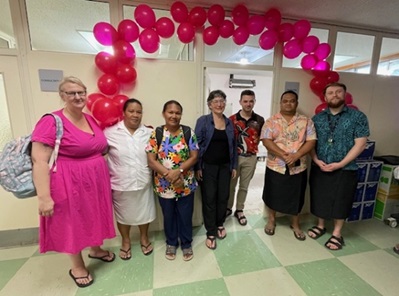
Grand opening of the Ear Health clinic
In partnership with Tuvalu’s Ministry of Health, RACS Global Health established a permanent Ear Health Clinic at Princess Margaret Hospital. The clinic has been equipped with essential instruments and medications, with a donated ENT microscope en route from Australia.
Three specialist volunteers delivered foundational training in primary ear care and basic audiology, using the WHO Primary Ear and Hearing Care manual alongside supplementary materials. The training combined classroom learning with extensive clinical exposure, including hospital consultations and school visits to follow up children identified earlier in the year through the Christian Blind Mission screening program. By the end of the visit, local staff were confidently identifying and managing common conditions such as otitis media with effusion, chronic ear discharge, perforated ear drums, and early cholesteatoma.
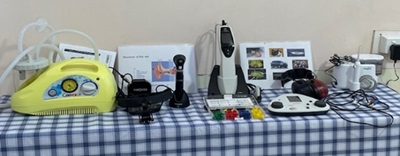
Equipment acquired in clinic set up
The visit showed that it was feasible to set up an equipped ear clinic and to provide a foundational level of training in one to two weeks. With DFAT support, RACS Global Health could consider this model to be set up in other Pacific countries that lack basic ENT/ear health services. This serves the dual purpose of reducing the burden of significant hearing loss and ear disease in the population and improving the effectiveness of surgical visits.
A weekly full day ENT clinic has now been agreed upon, with scope to expand as staffing grows. Further audiometry skills, particularly masking techniques, will be added during the next RACS deployment this year.
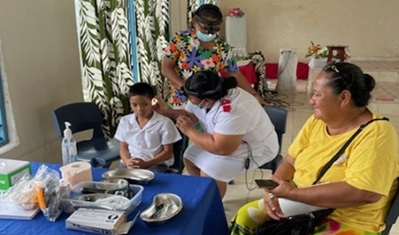
Local trainee attending to a patient in a school
Sustained progress will require continued mentoring for the local ear nurse, ideally with additional support from an experienced Pacific ear health specialist. With stronger coordination between RACS, local services, and schools, Tuvalu is now well placed to align with broader World Bank and WHO hearing health initiatives and future funding opportunities.
This successful visit demonstrates a scalable model for strengthening basic ear health services across the Pacific. We look forward to sharing more of the outcomes of Global Health initiatives such as this.