2026 | Volume 27 | Issue 2
We have many items in the RACS Heritage collection, but often more is revealed by visitors who are still connected to its provenance.
Recently, descendants from the McCrae family visited the RACS museum hoping to view Farquhar McCrae’s sword and scabbard, and his portrait (PDF 172.63KB).

The sword
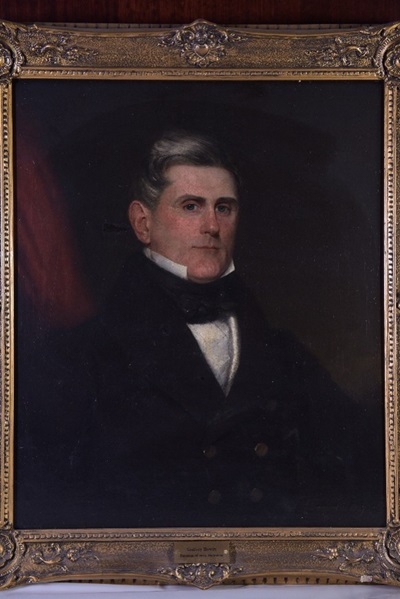
Farquhar McCrae's portrait
When the RACS curator shared the provenance of the items, Andrew Westbrook, a descent of the McCrae’s family noted: “It is both incredibly interesting and surprising to read the notes and find out the origins of these special items. We now realise how serendipity has played a role in preserving various parts of the family history for over 200 years.”
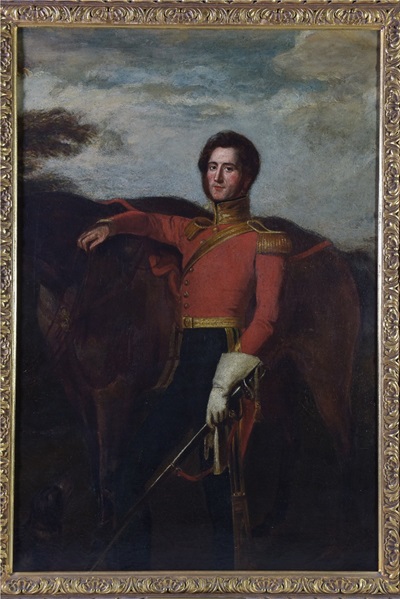
McCrae's equestrian portrait painted by Georgiana Huntly McCrae
It is an imposing equestrian portrait of a young early 19th century military surgeon, painted by McCrae’s sister-in-law, Georgiana Huntly McCrae.
Farquhar McCrae was born at Westbrook near Edinburgh, into a distinguished Scottish family. He was educated at the University of Edinburgh and graduated with an MD in 1827. After a sojourn in Paris, he joined the staff of the general hospital at Chatham. Here he suffered an injury during a dissection, which impaired his health for the rest of his life. He was appointed curator of the museum at Chatham and put together a notable collection of pathological specimens.
In 1838 he sought to resign on the grounds of ill health and was then offered a posting with the 6th (Inniskilling) Dragoons. But with his health still poor, he decided to emigrate to a kinder climate, and arrived in Melbourne aboard the barque Midlothian, together with his wife, two children, mother and two sisters.
McCrae set up practice in Bourke Street with his brother-in-law, David Thomas. Both were pioneers in the use of anæsthetics. McCrae was the first to introduce chloroform, Thomas ether.
Sometime after 1841 McCrae moved to Sydney, where he was one of the first medical practitioners appointed to the staff of the Sydney Infirmary and Dispensary. He died in Sydney at the age of 43. His remains were brought back to Melbourne and originally interred in the General Cemetery (later acquired for the Queen Victoria Market). He now lies beside John Batman in the Fawkner Cemetery.
In 1952, Mr J. H. Freeman, a McCrae descendant, contacted Dr Henry Searby at the College after speaking with Daryl Lindsay. Lindsay was connected to the College through his friendship with Sir Henry Newland, formed during his service as a war artist in World War I, and he was often consulted for art related advice as a former Director of the National Gallery of Victoria. Freeman had offered to sell the portrait his mother owned to the College for 50 guineas. Dr Searby was an eminent surgeon, Censor-in-Chief of RACS from 1949 to 1954, and vice president from 1954 to 1957.
The portrait was painted in 1837 by his sister-in-law Georgiana McCrae. She went on to be celebrated for her diaries edited by her grandson and published as Georgiana’s Journal in 1934.
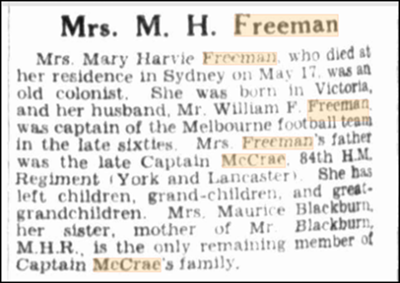
The portrait was acquired and is now on display in the College.The family were surprised to read that J H Freeman held the painting of Farquhar as they thought one of Farquhar’s children would have held the painting. J H Freeman was presumably one of Mary Harvie Freeman’s (nee’ McCrae) children. Mary was the fourth daughter of Captain Alexander McCrae (1799-1871) and married William Freeman in 1869.
The surprise was compounded by a letter dated 25 August 1952, which reveals that Daryl Lindsay was the one who suggested the painting be given to the Royal College of Surgeons. Daryl Lindsay was connected to the College through his friendship with Sir Henry Newland as a war artist during World War 1. His original watercolours of injured soldiers were donated to the RACS Archive.
The story behind the College’s acquisitions of Farquhar McCrae’s sword and how it links back to the early Melbourne family; the Howitt’s is also fascinating.
The sword is a dress sword of the 6th Dragoons. Made by Henry Wilkinson of Pall Mall, it is 38 inches (96.5cm) long and has an elaborately engraved and highly polished steel blade. Being a ceremonial weapon, the blade is quite blunt, and it is therefore unlikely to have been among the first surgical instruments used in Port Phillip. The gilt guard bears the crown and monogram of Queen Victoria, which dates the sword to late 1837 or 1838. The grip is bound in snakeskin, and the sword is carried in a leather scabbard with brass mounts.
Selwyn Taylor visited his cousin, Alaric Howitt, in 1959 and noticed he owned Farquhar McCrae’s sword. It was displayed on his piano, and he suggested donating it to RACS as a companion piece to the portrait. Alaric agreed but never shared how he came to be the custodian of the sword.
Farquhar, Andrew (Georgiana’s husband) and Alexander McCrae family knew the Howitt’s well from their earliest days of Port Phillip. Alfred Alaric Howitt noted in his letter in the RACS Archives that Farquhar McCrae was his great, great uncle. The first Howitt to arrive in Port Phillip was Godfrey Howitt on 7 April 1840. The College also has his portrait, which sits next to McCrae’s.
Dr Godfrey Howitt’s first son, Dr William Godfrey Howitt, married Sarah Agnes McCrae, who was the second daughter of Captain Alexander McCrae. It seems appropriate that Dr Geoffrey Howitt’s and Farquhar McCrae’s portraits still hang together all these years later. Howitt’s portrait came into the care of the collection on the advice of Sir Daryl Lindsay in 1970.
For many years the sword hung in the foyer of the College, beneath the portrait of Farquhar McCrae, until it was broken in an act of frustration by a disappointed Fellowship candidate. It was returned to Wilkinson’s, repaired, and safely returned to RACS.
This story shows the close connections many pioneering families had with one another in early Melbourne days, and how heritage objects remain important links to the pioneering days and early medical practice in Australasia.
References
28 Oct 1869 - Family Notices - Trove 21 May 1938 - Mrs. M. H. Freeman - Trove
RACS Archives