2026 | Volume 27 | Issue 2
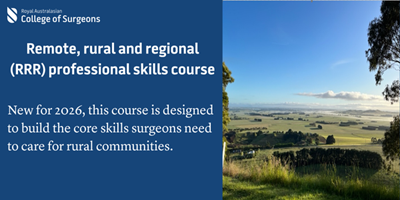
The Royal Australasian College of Surgeons (RACS) has launched a new free online learning module designed to equip surgeons and Trainees with the additional knowledge and skills needed to care for rural, remote and regional (RRR) communities.
The Remote, Rural and Regional Professional Skills course is a seven part, self paced program covering:
• Rural health equity: Geographic classifications, healthcare quality, rural health outcomes and advocacy
• Health systems for equity: Place based models of care, scope of practice, and the principles of generalism and rural generalism
• RRR context: Understanding new practice environments, cultural determinants of health for Aboriginal and Torres Strait Islander people and Māori, community contexts, and the impacts of climate change on rural health
• Rural professional practice: Rural medical culture, professionalism, ethics, sustainable practice, wellbeing and fatigue mitigation
• Contextual decision making: Whole of person care, Rural focused urban surgical (RUFUS) and rural surgical practice, cost conscious care, reflective practice, and outreach/locum considerations
• RUFUS practice: Supporting rural generalism and collaborating effectively with rural teams
• Virtual healthcare and teams: Telehealth, safe handover, communication across dispersed teams, retrieval and transport, and professional networks.
The course provides a standardised teaching and learning environment for the new RACS Remote, rural and regional professional skills curriculum. Led by Dr Bridget Clancy, the course was developed by the Rural Surgical Curriculum Working Group, chaired by Dr Jonathan Fong. Funding was provided by the Australian government’s Department of Health, Disability and Ageing through the Specialist Training Program (STP).
“Rural people have all kinds of health problems and need all kinds of surgeons. All surgeons need skills to care for rural people, through rural practice and rural focused urban practice (RUFUS). The RACS Remote, rural and regional professional skills course supports the development of these skills, through rural and RUFUS practice, virtual healthcare and collaborative care in virtual and geographically dispersed teams,” says Dr Bridget Clancy.
Those who complete the course will strengthen their abilities in rural practice, RUFUS practice, contextual decision making and virtual care.
The free, on demand e learning module is now available to Fellows, SET Trainees and SIMGs.
Register for the course here: https://elearning.surgeons.org/course/view.php?id=683