2026 | Volume 27 | Issue 3
Australia’s first Clinical Care Standard for emergency laparotomy was officially launched at the Royal Australasian College of Surgeons (RACS) Annual Scientific Congress (ASC) on 1 May 2026.
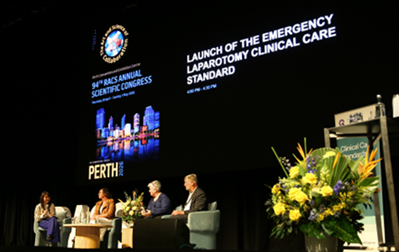
Emergency Laparotomy CCS launch panel
Developed by the Australian Commission on Safety and Quality in Health Care (the Commission) with guidance from an expert topic working group, the Standard is endorsed by 20 professional organisations. This includes RACS, General Surgeons Australia and the Colorectal Surgical Society of Australia and New Zealand.
The Standard is underpinned by a robust evidence base including the Enhanced Recovery After Surgery (ERAS) Society guidelines for emergency laparotomy and builds on the work of the Australian and New Zealand Emergency Laparotomy Audit – Quality Improvement (ANZELA-QI).
At the launch, Professor David Watters, FRACS—Alfred Deakin Professor at Deakin University and Barwon Health and Director of Surgery at Safer Care Victoria—outlined the context for the Clinical Care Standard. With 15,000 emergency laparotomies conducted in Australia each year and a mortality rate of around seven per cent, it is among the highest-mortality emergency surgical procedures.
Local and international evidence demonstrate the effectiveness of quality improvement initiatives. Following the introduction of the UK’s National Emergency Laparotomy Audit (NELA), for example, postoperative mortality fell from 11.8 per cent to 8.1 per cent in a decade. In Australia, alignment of Clinical Care Standards and Clinical Quality Registries have been successful in driving improvement, such as in the case of hip fracture.
Conjoint Professor Carolyn Hullick, Chief Medical Officer at the Commission and an emergency physician, explained the role of the Commission in developing national Clinical Care Standards that address unwarranted variation in care for specific conditions or procedures. She also outlined the development process for the Standard.
Professor Hullick provided an overview of the nine quality statements that address key priorities for quality improvement (see Box 1). These can be considered under four broad themes.
- Time-critical management – addressing the need for rapid identification, assessment and escalation of patients who may require an emergency laparotomy. This encompasses consideration of sepsis, use of computed tomography, prompt surgical referral of critically ill patients and ensuring timely access to surgery.
- Risk-informed decision making – including assessment of patient risk using a validated tool such as the NELA risk calculator in combination with clinical judgment, and assessment of frailty in older adults. This supports appropriate planning, including identification of those who are high risk and most likely to require the presence of consultant doctors during surgery and benefit from postoperative critical care.
- Shared decision making and goals of care – including the importance of involving senior clinicians and using structured approaches to shared decision making, especially when patients and families are considering potentially non-beneficial surgery.
- Collaborative management of older people – based on strong evidence demonstrating that comprehensive geriatric assessment and management reduces mortality and length-of-stay for elderly patients undergoing emergency laparotomy.
Professor Hullick also explained that the Standard includes a set of indicators aligned with ANZELA-QI indicators and information to help clinicians and healthcare services considering local implementation. This includes in rural and regional areas and services where patient transfer may be considered for investigations, treatment or postoperative care.
Providing insights from clinical practice, Dr Jacinta Cover—general surgeon and Co-Director and Head of Surgical Specialties for WA Country Health Service South West at Bunbury Hospital—joined Professor Watters and Professor Hullick for a panel discussion. This panel was chaired by Dr Audrey Koay, Executive Director Patient Safety and Clinical Quality Directorate with the WA Department of Health.
Dr Cover outlined key elements of Bunbury Hospital’s successful approach to quality improvement, including:
• regular review of monthly ANZELA-QI data at morbidity and mortality meetings
• sharing of this data and quality improvement priorities with other teams within the hospital
• embedding risk and frailty assessment into the team’s standard ways of working.
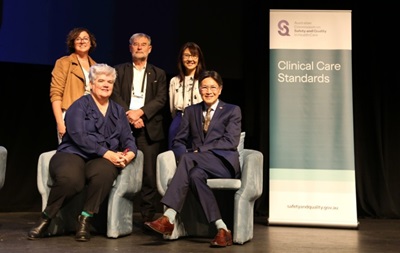
Professor Owen Ung, outgoing president of RACS, launched the
Standard on behalf of the Commission.
In his closing remarks, Professor Ung highlighted the value of the Standard, commenting, “Measurement and quality improvement optimise outcomes. Although important, it is not enough to be learning by anecdote, experience and pattern recognition. Instead, we need to bring science to critical treatment pathways, which should be auditable, measurable and predictable.”
The Commission is grateful for the support of RACS during the development of the Standard and looks forward to continued collaboration, as this important Clinical Care Standard is implemented throughout Australia.
Find out more at safetyandquality.gov.au/el-ccs
Quality statements from the Emergency Laparotomy Clinical Care Standard
1. Rapid assessment and escalation
2. Diagnostic imaging
3. Assessment of risk
4. Shared decision making and goals of care
5. Timely access to surgery
6. Presence of consultant doctors during surgery
7. Postoperative critical care
8. Proactive assessment and collaborative management of the older patient
9. Transition from hospital care