2026 | Volume 27 | Issue 3
Author: Professor Glen Farrow OAM FRACS
Recently I started a professorial position at a university. I was reminded of the immortal line “those who can, do; those who can’t, teach”i . The university likes its doctors to do a bit of teaching, so I took on Problem Based Learning (PBL) tutorials, filling in when other tutors (now called facilitators) were on leave.
Being a postgraduate course, the students are a little older, but they don’t all have the same undergraduate degree. Especially in first and second years, there’s no safe way of assuming a baseline of knowledge. Add to that the approach of teaching through PBLs and body systems, rather than traditional subjects such as anatomy, pathology and biochemistry. You then have a situation akin to throwing everyone into the deep end along with their lecture notes and hoping they will learn to swim.
For those with a science background it seems to work; for those from the arts, humanities and even dance, its brutal.
During a recent Year One PBL on hepatitis we were working through the presenting complaint and the various possibilities. I was explaining liver function tests and jaundice, in particular changes in transaminases versus alkaline phosphatase. Being a surgeon, I gravitated towards obstructive jaundice and stones in the biliary tree.
“What (pray tell) is a biliary tree?” I was asked.
Luckily, I came prepared because in 1983 Dr Rowan Webb, surgeon at the Royal Melbourne Hospital, taught us how to answer exam questions—even if we didn’t know the answer.
“The biliary tree drains the liver of bile, looks a bit like a tree, and is made up of bile ducts.”
“Ducks?” the wide eyed student asked me. “Did you say ducks?”
There was a moment of silence, a pregnant pause with the expectation that this was a joke, but alas it was not.
I dislike saying “in my day”, but in my day there would have been hysterical laughter, followed by ritual humiliation, but not now. In that brief moment between comprehending the question, keeping a straight face and considering an answer I was transported into a world of biliary ducks.
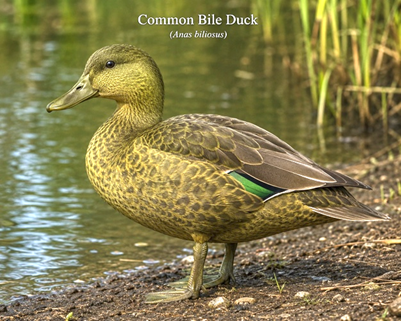
Of course, everyone knows the Common Bile Duck, occasionally seen with the lesser known Accessory Bile Duck. The Common Bile Duck is large, generally green, fairly placid and easily found in the middle of the tree. It’s happy to be poked and prodded and even explored, but if damaged keeps quietly leaking everywhere until someone eventually notices days later, when it’s too late to prevent biliary peritonitis. Silent but deadly.
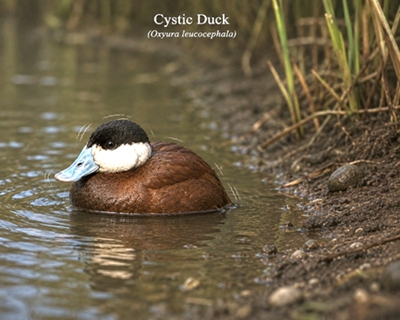
The Cystic Duck is smaller and less predictable. It can sit close to the Common Bile Duck, or further away on another branch of the biliary tree. It is justifiably nervous. All anyone ever wants to know is where is it from, and how to clip it. Indeed, it’s very important to find just which branch this little duck is sitting on, lest you clip the tree and not the duck. Clipping the tree is similar to clipping the wrong duck. It ruffles feathers and creates quite a mess.
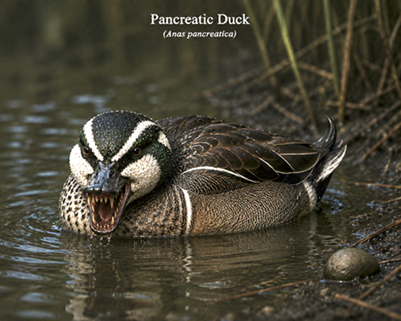
At the base of the tree sits a very nasty temperamental little duck, the Pancreatic Duck. It often hides and if instrumented can react very badly. A damaged, leaking Pancreatic Duck likes to create a god almighty fuss, sharing the joy by damaging as many surrounding organs as it can. It will lay quite large eggs known as pseudocysts in hard to reach places. This puts interventional radiologists in heaven, and surgeons in despair. The three rules of surgery are based on the fear of this slippery little ducker.ii
“Eat when you can, sleep when you can, don’t mess with the pancreas.”iii
Snapping out of my daydream I realised the first year student with a humanities background was actually expecting an answer about biliary ducks. Remembering there is no such thing as a silly question, and that it’s the depth and breadth of knowledge in the room that makes this type of learning so effective, I apologised explaining I had misheard them.
“Must be getting old and deaf,” I said self-deprecatingly.
Which probably explains why I didn’t hear them call me a silly old quack …
References
i George Bernard Shaw, Man and Superman, 1903, often wrongly attributed to Charlie Brown
ii SPC Fruit Advertisement https://rachelarthur.com.au/wp-content/uploads/2021/05/Slippery-sucker.mp4?_=1 accessed 18 May 2026
iii Greys Anatomy Dec 2010 https://abc.com/news/504b7496-83e1-460e-a241-3b49a07ba9c2/category/740480 accessed 18 May 2026.