2026 | Volume 27 | Issue 3
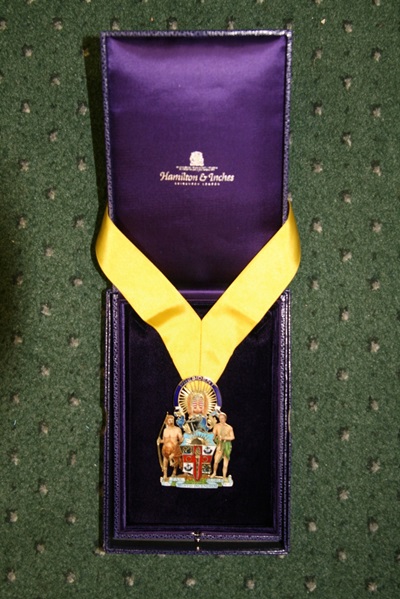
As the senior office-bearer of the College, the president is entitled to wear a badge of office at official functions and when representing the College elsewhere. This is a venerable tradition among many colleges and societies, including the other surgical colleges. Some colleges have badges for all their significant office-bearers, such as president, vice president, past president, honorary secretary, honorary treasurer and chairs of senior Boards. However, the Royal College of Surgeons of England (RCSE) has only one badge of office, for the president, which was presented to that College in 1904 by the then resident, Sir John Tweedy. It is prominently displayed by Sir Peter Morris, the recently retired president of the RCSE, in his official portrait.
The badge of the president of the Royal Australasian College of Surgeons (RACS) is the gift of the Royal College of Surgeons of Edinburgh.
Following the 1968 Annual Scientific Meeting held in Adelaide, Dr John Cameron, resident of the Edinburgh College, wrote to Dr Benjamin Rank, who had just stepped down from his term as president, thanking him for his hospitality and noting that the resident of RACS did not have a badge to wear. He offered to provide a badge on behalf of his College as a token of friendship and cordiality between the two Colleges.
Council reacted positively to this proposal. A suggestion that the president be provided with a badge of office had already been made by Dr Patrick Kenny to Dr Benjamin Rank in May 1968, shortly before a similar proposal arrived from Edinburgh. This convergence of ideas suggests that the concept of a ceremonial badge was very much in the minds of Councillors at the time. At the Council meeting in June 1968, Dr Kenny formally moved that the president be provided with a badge of office, and the motion was carried.
An official letter of offer was received from Edinburgh on 5 August 1968, and the new president, Stanley Reid, replied to Dr John Cameron on 30 August. It was agreed that the form of the badge should be the coat-of-arms of the College, and the only point of discussion was whether the ribbon should be green or gold. Council favoured gold.
The badge took many months to produce. It was fashioned in Edinburgh and dispatched to Melbourne in May 1969. Dr Stanley Reid served only one year as resident, so the badge arrived just in time for him to wear it at his last Council meeting. It fell to his successor, Patrick Kenny, to be the first resident invested with the badge of office.
The badge shows the College coat-of-arms complete with motto and enamelled in full colour. Around the sunburst at the top is a band inscribed ‘President’. The badge measures 97 x 64 centimetres and weighs 102 grams.
When you view the past presidential portraits within the College offices, there is diversity in the choice of gown worn but the President’s badge is always evident.