2026 | Volume 27 | Issue 3
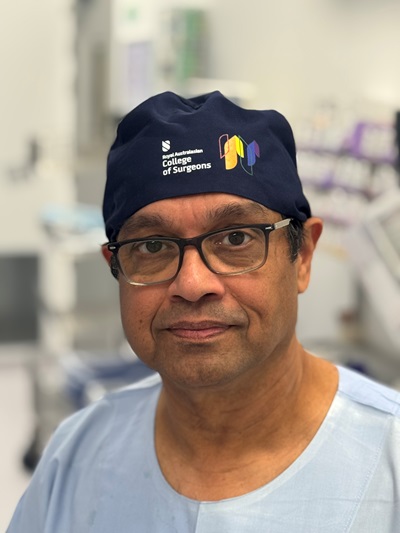
Prof Gordon Thomas
It’s an operation few in the world have performed. Conjoined twins, two tiny human lives sharing the same liver and vital organs, are dying.
Surgeons in Papua New Guinea (PNG), where they were born, have told the family there is nothing they can do to help. But they reach out to a team of specialists in Sydney, Australia, led by paediatric, general and transplant surgeon Clinical Professor Gordon Thomas, FRACS and ask them to take a look.
Professor Thomas and his team travel to PNG and give the family a glimmer of hope. They believe the surgery can be performed, but one of the twins will have to die to give the other a chance to live.
Then it becomes a race against the clock to get the twins to Australia, secure the approvals and bring together the team needed to perform the complex surgery on two babies weighing about 1.4 kilograms each.
It is in these moments that Professor Thomas says the noise disappears and he becomes like a "conductor of an orchestra".
He trusts each member of the vast team involved in the complex task of saving these babies' lives to do their part. This includes chaplains helping the parents through the difficult decision of letting one child die to save another, to the anesthetists managing medication and the administration team sorting out paperwork.
Every person plays a vital part and, when they play together, as they did to save the life of Sawong Kevin in December, it becomes a symphony.
“For very complex surgical endeavors like this, meticulous planning, coupled with working collaboratively and harmoniously together is vital for success.”
The move from a remote village in PNG to a major Australian hospital is overwhelming for the family.
Professor Thomas says they were supported every step of the way by social workers, chaplains, members of the PNG community in Australia and local churches who rallied around them during an incredibly difficult time.
Professor Thomas is familiar with high-risk procedures through his work in transplant. However, a case as complex and rare as the separation of the twins like Sawong and his brother Tom is especially challenging. There’s a need to be creative and to innovate.
It's not a job; it's a calling and one that requires sacrifice.
"When you put your hand up to take something like this on, you know it is going to involve a lot.
"You are putting your hand up for very hard work. It is not an eight-to-five job.
"There are risks, high risks, and families understand that. Sometimes I feel overwhelmed by the level of trust they place in us for their children to pull through.
"My wife is very supportive, as many times I have had to forego social occasions and plans. But when you choose to take something like this on, you have to see it through."
Professor Thomas says he feels a moral responsibility to take on challenges and high-risk procedures when there is a chance it could save a child's life, even when he knows the personal and professional challenges that lie ahead.
"If we have the skills, the team and the opportunity to help, then I think we have an obligation to explore those possibilities," he says.
Not all cases end well and that can be hard.
It's offset by the enormous success stories and the knowledge that, without intervention, the child would not have stood a chance.
"The ability to do something good and save a person's life and give them a reasonable quality of life back with their family, that's a big reward in itself.
"But it isn't the surgeon alone. It is very much the team that surrounds them.
"When I say, 'I can do this', although I know it's going to be really hard and challenging, I say this only with the knowledge that I am only one member of a big team and that teamwork is what is needed to make it happen."
The success of the PNG twins separation depended on international collaboration between multiple staff from the Children’s Hospital at Westmead, the Sydney Children’s Hospital and the PNG team who initially cared for the twins.
Many of the clinicians in PNG were already known to Professor Thomas because of collaborative training opportunities, often supported previously by the Royal Australasian College of Surgeons (RACS). This is something he hopes will continue to expand.
With regards to liver transplants in children, Australia has many things to be proud of says Professor Thomas. For instance, “we have zero mortality on the waiting list. Very few countries are able to achieve this. Not only that, the outcomes for these children's long-term survival are excellent. Thanks to Australia's advanced organ donation system, it is only in very rare cases that parents are used as donors in liver transplants.
"We get enough from the deceased donor pool," Professor Thomas says.
Looking back at the PNG twins, he admits he understood the separation would be challenging with the almost certain death of one twin, Tom, due to anomalies that were incompatible with life. Sawong had a chance of survival but there was uncertainty about what post separation course would look like.
That is why Sawong's progress has been so remarkable.
"He's doing extraordinarily well and surprising all of us," he says. "To see him thriving after where he started is incredibly rewarding."
Looking to the future, Associate Professor Thomas is excited by the opportunities artificial intelligence will provide in robotics, research and streamlining administrative tasks.
For children who receive organ transplants, the “holy grail” is tolerance—where children don’t reject their transplanted organs and don’t need immunosuppression for the rest of their lives. This is still to be found and something he is hoping to see happen in the future. He’s privileged to be working on this with a group of clinicians and scientists at the Children’s Centre for Transplant and Research at Westmead.