2026 | Volume 27 | Issue 3
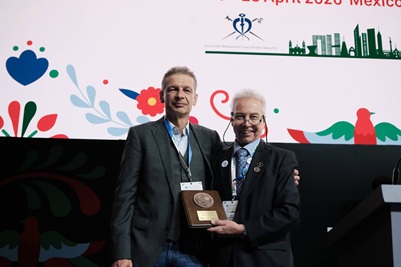
Prof Balogh receiving the Richard Danis Prize from
Prof Ari Leppaniemi,president of International Surgical Society
For more than two decades, Professor Zsolt J Balogh has worked at the forefront of trauma care, treating some of the most severely injured patients. This year, his contribution to the field was recognised with the Robert Danis Prize, one of the highest honours in international trauma surgery. Established in 1947 by the International Society of Surgery, the award recognises biennially a surgeon who has made exceptional contributions to the care of injured patients.
"I feel both honoured and humbled," says Professor Balogh, Director of Trauma Services and Professor of Surgery and Traumatology at the University of Newcastle.
But for Professor Balogh, trauma care has never been about individual achievement. "Nothing in trauma care can be achieved by a surgeon working alone. Not even a trauma service or a trauma department can do anything without being in a highly functional tertiary-level hospital. We need the whole multidisciplinary network."
Although practicing as an orthopaedic surgeon, Professor Balogh's training and work extends far beyond bones and fractures. His research has helped transform the understanding of polytrauma—multiple serious injuries of a person.
For years, patients with multiple serious injuries were viewed as having a collection of separate injuries. Professor Balogh helped change that thinking, arguing that polytrauma should be recognised as a disease in its own right, with effects that extend far beyond the initial injuries.
"The outcomes are much worse than expected based merely on the sum of injuries," he says. "Overall, they have a shorter life expectancy than their uninjured peers, even if they appear to have recovered completely."
His advocacy contributed to the recognition of polytrauma within the World Health Organisation's ICD-11, a change he believes will reshape trauma care worldwide.
Over the years, Professor Balogh has helped move treatment away from excessive intravenous fluids and towards resuscitation using blood and blood products—an approach now used in civilian and military medicine. He has also played a leading role in reducing deaths from severe pelvic fractures, where Australia now records some of the best outcomes internationally.
His other contributions include injury severity scoring, preventing abdominal compartment syndrome, characterising postinjury multiple organ failure and improving the timing of fracture surgery.
The impact is reflected in survival rates. "When I started training, mortality among severe polytrauma patients was about 30 to 35 per cent in leading trauma centres. Now, in the best centres, it's less than 15 per cent, sometimes less than 10 per cent."
Born and educated in Hungary, Professor Balogh's interest in trauma surgery began early. Growing up near the busy highway linking Istanbul and London, he regularly witnessed the consequences of serious road crashes. "I saw friends and many people who died on those roads. I always wanted to help."
At the age of seven, he helped save his mother's life after a severe bleeding episode. "I managed to control her bleeding and call the ambulance. At seven years old, you realise you probably have a reasonable chance that you will be good at this."
He trained and practiced in Europe, United States and Australia. After a Fellowship in Sydney, in 2003, he was recruited from Hungary in 2005 to John Hunter Hospital in Newcastle, one of New South Wales' busiest trauma centres.
"It looked like I could do a lot. The trauma centre was much busier than most in Europe."
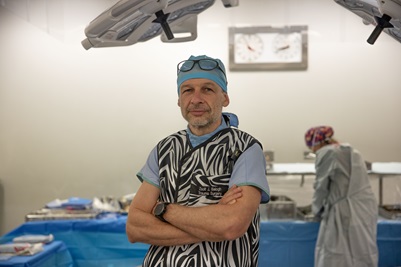
Prof Zsolt Balogh
For almost a decade, he has been leading the Trauma Care Verification Program across Australia and Aotearoa New Zealand. The program examines every stage of treatment—from ambulance response to rehabilitation. Verified trauma centres achieve lower mortality rates, shorter hospital stays and better outcomes.
"Australia’s major trauma mortality rate is comparable with the best-performing countries in the world," he says, citing the Netherlands, Norway, Germany and Switzerland.
Beyond Australia, he has advised trauma systems across North America, Europe, the Middle East and Asia. As president of the Australian and New Zealand Association for the Surgery of Trauma and Deputy Editor-in-Chief of the ANZ Journal of Surgery, he continues to influence trauma care internationally.
Despite the awards, Professor Balogh says he remains driven by unanswered questions. "The fundamental interest of solving the puzzle of how injury makes people sick has never changed. I have more questions than I can address in my professional life."
Outside medicine, his focus shifts from damaged bodies to damaged ecosystems. He is deeply involved in conservation and ecological restoration. "I'm dedicated to helping restore injured or abused ecosystems."
For Professor Balogh, the passion for ecological restoration reflects the same instinct that drew him to trauma surgery as a child: the desire to repair damage and restore function.