2026 | Volume 27 | Issue 4

Author: Associate Professor Felix Behan, FRACS, AM
Perfection is one of the keynote edicts in plastic surgery and my recent medico-legal case became the basis for this story.
I came across this image of a ballerina, En Pointe, from the Victorian State Ballet mirroring perfection.

Image from the Victorian State Ballet
This story helps me recall the Chinese ballet exponent Li Cunxin—Mao’s Last Dancer’—when Mao’s wife recognised his talent, sent him off to ballet school, exonerating him from military commitments. He eventually became artistic director of the Queensland Ballet. This sequence has applications in plastic surgery where instinctively one can recognise talents.
Medico-legally, reports must be used as a teaching tool. In one of my recent cases, a young man needed a skin graft following a motor vehicle accident—harvested from the thigh. Obviously, the drum Dermatome may have not been available and the outcome from the Braithwaite knife for harvesting skin grafts lacks refinement. The wound healed through a hypertrophic phase and resulted in constant pruritis of the thigh, a source of mirth among his schoolmates and the psychological effect needs no elaboration.
We have been spoiled as surgeons with the fenestrations of a drum Dermatome producing rapid healing in donor/harvest sites.
Back to another ballet phase of perfection when I saw a documentary on Anna Pavlova, the Russian ballerina, in her swan costume performing elegantly. She was a symbol of elegance and the graceful swan was her favourite bird, reflected in the collection she kept at her country estate. When Pavlova died the mother swan died soon after. Why do animals perceive this separation from nature? We often see it when dogs typically whine following their owner’s demise.

Pavlova on stage with her swan costume
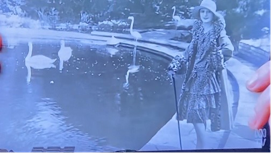
Pavlova relaxing with her swans
Such was Pavlova's fame during her world tours that chefs created dishes in her honour, much as the Peach Melba was named after Dame Nellie Melba. The pavlova has since become a Christmas favourite, often topped with fresh fruit. Australia and New Zealand still dispute its origins across the Tasman, but most would agree that the dessert is here to stay.
My New Zealand colleague, the late Bill Manchester, operated under the umbrella of 'Perfection' such was his talent and his biography, co-authored by Earle Brown, was titled likewise. His guiding principle was simply: ‘Only the best will do’. That commitment to excellence remains one of the hallmarks of plastic surgery when others try their luck with questionable outcomes, pertaining to the case referred to above.
Voltaire said it well: “The best is the enemy of the good”—our plastic surgical edict—not dermatological where granulation healing is often the fallback situation.
Plato believed that beauty and perfection were one and the same, and there remains much wisdom in that classical view.

Perfection in tree branches reflecting the Fibonacci ratio

The disc of the daisy: perfect rhythmic symmetry
This image of a balloon in the morning light in Parkville, with the branches of the tree in Fibonacci format seeming to frame the elegance, is like a painting. I am a Parkville resident for the past 50 years thanks to Sir Benjamin Rank (Benny).
Having read recently about the importance of the Fibonacci numbers and the spiral grooves impressed on the snail’s shell is another example of nature’s perfection. Besides the backyard, one can enjoy this vision directly when elegantly eating escargot at the restaurant Les Deux Magots in Saint-Germain. Just another reminder how nature always gets it right, and we try hard to emulate it.
In the human face, beauty is reflected in this golden ratio, and the closer the proportions are to this, the more pleasing is the result. As reconstructive surgeons we continue to strive for perfection, yet even the best microsurgical outcomes have their limitations and cannot match nature’s gift with surgery maintaining the essence of treatment. And the Sir Harold Gillies edict of matching like-for-like is a compromise in seeking satisfactory outcomes.
In conclusion, the Dr Ralph Millard story with Gillies is worth repeating as the basis for another story about perfection. Being one of Gillies’ proteges, Millard closed a wound following his American style. Gillies inspected the wound and took out 16 of the 17 sutures saying, “Now I will show you how to close a wound.”
As Napoleon recognised, any setback has its merits, and we learn from our mistakes throughout our surgical careers.
Once, the late Professor Don Marshall was harvesting a plantaris graft for Benny’s tendon repair in the hand. Don, with his usual flippant cackle, was reprimanded by Benny for his delay, but Don had the last laugh: “Sir, it is ready for you”. That quietened all reprimands.
I conclude with a sporting slant when Vince Lombardy, one of the great American gridiron coaches whimsically said, “Perfection is not attainable, but if we chase perfection, we can catch excellence.”