2026 | Volume 27 | Issue 4
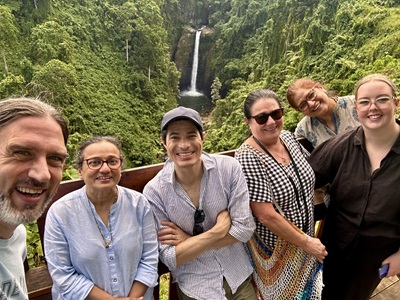
The RACS Global Health team
For paediatric surgeon Dr Stephen Adams, FRACS, a first RACS Global Health mission to Samoa became much more than a week of operating.
In June, Dr Adams led a Royal Australasian College of Surgeons (RACS) Global Health Visiting Medical Team (VMT) to Apia, Samoa, working alongside local clinicians to provide specialist paediatric surgical care and strengthen local capacity. The team of surgeons, anaesthetists and perioperative nurses from Australia and Aotearoa New Zealand volunteered their time and expertise to support children with limited access to care.
Funded by DFAT and supported by Children First Foundation the mission combined clinical care with training and mentoring for local healthcare professionals.
For Dr Adams this was his first trip with RACS Global Health. He put up his hand for this mission “to provide support and development to our Pacific neighbours.
“In Aotearoa New Zealand, we have close ties with Pacific Island nations, and there is a strong sense that we should support our Pacific neighbours where we can,” he says.
Having volunteered since his teenage years, Dr Adams values the opportunity to experience different cultures, communities and perspectives.
“It was a privilege to join Dr Celine Hamid—a fellow paediatric surgeon—and other team members with experience of operating in Samoa. Their knowledge and extensive contribution ensured we had a successful trip.”
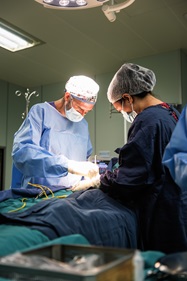
Dr Adams in the operating theatre
During the week, the team treated children with a range of complex colorectal and urological conditions, many of whom had experienced significant delays in accessing specialist surgical care.
For children and families, these procedures can be transformative. Conditions considered routine in larger health systems can profoundly affect a child's health, development and quality of life if left untreated.
But it is often the people—not the procedures—that leave the strongest impression on volunteers.
For Dr Adams one experience stood out. “There was a lovely little boy with a congenital anorectal malformation. He had been managed with a colostomy for years and it was extremely rewarding to perform an anorectoplasty for him during our visit. He was delightful to look after, always smiling and happy. I'm looking forward to seeing him next year. If things go well the local surgical team will be able to close his colostomy in the next few months.”
While delivering surgical care is a central part of the mission, the Samoa program is equally focused on education and partnership. Throughout the deployment, local registrars, anaesthetic trainees and nurses worked together with the VMTs in clinics, operating theatres and teaching sessions. Visiting clinicians shared skills in patient assessment, operative planning, perioperative care and postoperative management, while local staff took active roles in patient care.
The VMTs described the Samoan registrars as engaged, motivated and eager to learn. Relationships built through previous visits enable ongoing mentoring and case discussions long after the visiting team has returned home.
One of the most rewarding aspects of volunteering for Dr Adams is seeing local clinicians grow “in confidence and capability”.
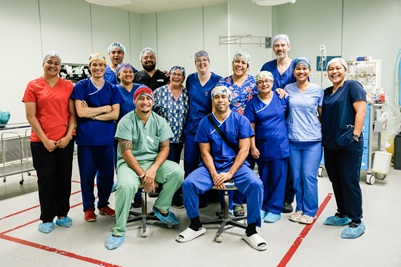
The surgical team
“The success of these visits isn't measured by how many operations we perform during a week. It's about building relationships, sharing knowledge and supporting local clinicians to manage increasingly complex cases themselves. If we can leave behind greater confidence, skills and ongoing support, that's where the real impact lies,” he says.
The visit also highlighted some of the challenges faced by clinicians working in resource-constrained environments. The team encountered shortages of equipment, consumables and sterilisation resources, yet were continually impressed by the commitment, adaptability and professionalism of local healthcare staff. Despite severe resource limitation, the surgical teams work really effectively and collaboratively.
Experiences like these often leave volunteers with a renewed perspective on their own practice.
Working in a different healthcare setting can sharpen clinical decision-making, encourage innovation and provide a powerful reminder of the privilege of practising surgery. Many volunteers return home with lessons that influence not only how they operate, but how they think about healthcare, teamwork and their role as surgeons.
“The experience reminded me that I always have something to learn. Working in a different environment challenges you to think creatively, adapt and focus on what matters most. You come away with a renewed appreciation for teamwork and for the privilege of being able to use your skills where they are needed.
“Being part of a team like this is just a small part of a bigger picture. The amount of coordination and logistical planning that goes into making these missions successful is due to the great behind-the-scenes work by the RACS Global Health team. Thank you for your support.”
RACS Global Health programs are designed to create lasting impact. While the immediate benefit is specialist care for patients, the longer-term goal is to strengthen local health systems through knowledge sharing, skills transfer and lasting professional partnerships. The RACS Global Health Samoa deployment demonstrated how those relationships continue to grow over time, helping improve access to surgical care for children across the region.
For Dr Adams, the experience is also an opportunity to encourage others within the profession to become involved.
“It was challenging, rewarding and deeply worthwhile. RACS Global Health allows us to support our Pacific neighbours while delivering the same standard of care we would expect at home.”
Looking back, Dr Adams says the lasting impact of the mission will not be measured solely by the operations performed. It will be measured by the children whose futures have been changed, the local clinicians whose skills continue to grow and the partnerships that will continue long after the visiting team has returned home.
RACS thanks the Australian Government Department of Foreign Affairs and Trade (DFAT) for its continued support of RACS Global Health programs, which help deliver specialist surgical care, training and capacity-building across the Indo-Pacific.