2026 | Volume 27 | Issue 5

Dr Chandan Jadhav
The morning after a 12-hour operation that transformed her second toe into a new thumb, Dr Chandan Jadhav’s patient woke with her hand protected in a cast. Only a small portion of the transferred toe was visible so the surgical team could monitor it.
Dr Jadhav told her the operation had been successful, then asked her to move her new thumb.
“She gave it a wiggle and was instantly overcome with tears of joy. Suddenly, everything clicked. For the first time in six months, she realised she had a thumb again. That moment was priceless,” Dr Jadhav says.
For Dr Jadhav, a plastic and reconstructive surgeon at Sunshine Coast University Hospital, it was a moment that compressed years of training, planning and responsibility into seconds. “It makes us feel we can really make a difference in someone’s life.”
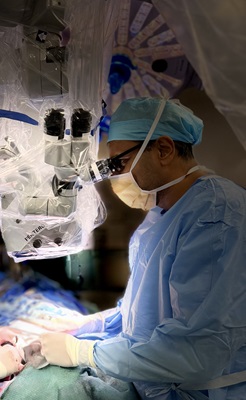
Dr Jadhav in the operation theatre
The procedure, performed in July 2026, was the Sunshine Coast’s first toe-to-thumb transfer. The patient, a woman in her 40s, had suffered a workplace accident when her hand became trapped in a conveyor belt. She lost almost her entire thumb and part of the thenar region of her hand. Losing a thumb can mean losing close to half of a hand’s function, Dr Jadhav says, affecting independence, employment and everyday tasks.
Before reconstruction could be considered, the injury had to be stabilised, and the wound covered with a free radial forearm flap from her uninjured upper limb. Months of rehabilitation, counselling and preparation followed.
“You have to treat the patient as a whole. They need empathy, they need hope and they need education.”
The operation demanded meticulous planning. Doppler studies and imaging assessed blood supply, while CT scans helped determine the length and position of the reconstructed thumb. Before fully detaching the toe, the team confirmed that its blood supply was adequate.
“If you don’t get things right, you’re putting the toe in the bin. So, you’ve lost not only the thumb, but also patient’s toe.”
The operation drew on two decades of microsurgical experience. Dr Jadhav had participated in a similar toe-to-thumb transfer during his training in India about 15 years earlier.
Born and raised in Bengaluru, India, his path into reconstructive surgery was not planned. During surgical training, an eight-week plastic surgery rotation changed his perception of a specialty he had largely associated with cosmetic work. He encountered burns, congenital hand differences and complex cancer reconstruction, and saw surgeons rebuild jaws, reconstruct breasts and create thumbs for children born without them.
“I was totally blown away. You can operate from head to toe. You can treat patients of all ages—from newborns to old people, and the possibilities and challenges are limitless.”
That same curiosity drives his commitment to research. For him, research is not separate from clinical practice. It helps surgeons assess techniques, measure outcomes and decide when a newer approach may offer patients something better.
“You get to know what the best possible options are and how you can measure your outcomes to give best possible results for your patients. Staying up to date with your cutting-edge technology and research is very, very important for a surgeon.”
He points to synthetic polymers and acellular dermal matrices as an example. In some wounds where surgeons may once have relied on complex free tissue transfer, newer materials can provide scaffolding for tissue regeneration and allow reconstruction with simpler skin grafting.
“Not doing fancy, complex, complicated surgeries is the solution. You can also have simple solutions, simple options, and those simple options again come through innovative research.”
Looking ahead, Dr Jadhav believes three areas will shape reconstructive surgery—supermicrosurgery, robotic microsurgery and tissue engineering.
At Sunshine Coast University Hospital, his team performs lymphatic supermicrosurgery, connecting vessels less than half a millimetre in diameter to redirect lymphatic flow into venous channels creating a bypass in patients with lymphoedema. Robotics may improve precision by reducing human tremor, while tissue engineering could reduce reliance on a patient’s own donor tissue.
For Trainees considering reconstructive surgery, he says the appeal lies in its breadth and its possibilities. “It’s really challenging, it’s problem-solving, and there is no limit.”
The woman whose thumb he rebuilt is already using it. Two months into rehabilitation, she can move it and pick things up, and the pins holding the bones in place are due to come out soon.
Twenty years of Plastic Surgery experience culminated in a 12-hour operation. Research helped show what was possible. For one patient, it meant getting back something she thought she had lost for good.