2026 | Volume 27 | Issue 5
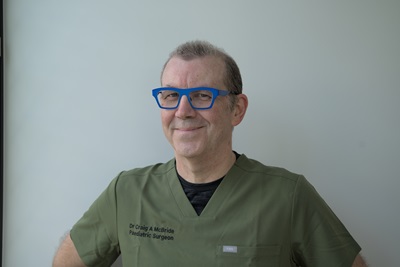
Professor Craig McBride
In the operating theatre, a surgeon’s focus narrows to one patient, one procedure and one outcome.
After years as both a paediatric surgeon and researcher, Professor Craig McBride understands the value of looking beyond that single moment of care.
Research, he says, is how surgeons turn the lessons of individual patients into knowledge that can improve care for many more.
“As operating surgeons, we treat one patient at a time; make a difference to one person at a time,” he says.
“With research that reach can extend and affect multiple people at a time, and for longer.”
It is a perspective he will explore at the RACS Annual Research Conference next month, where he will speak about research and what it means to be an academic surgeon.
“Academic surgery is a continuum, and we all occupy a place somewhere on it.
"An academic surgeon is someone who has, or inspires in others, curiosity, and then systematically sets out to answer those questions and share what they've learned," he says.
“That position can change throughout a surgeon’s career.
“Everyone is an academic surgeon during the lead into their Fellowship Examination, for instance. Some go on to teach, some to research, some to innovation. Some join labs, and some eventually lead labs or collaboratives.”
Changing patient care
Professor McBride points to Virginia Apgar’s work with newborn babies, John Snow and the Broad Street pump, and James Lind’s investigation of scurvy as examples of research changing care.
His own experience provides another.
“As a first-year medical student in 1989 I remember a lecture from Barry Marshall about a maverick idea he and J Robin Warren had. As a non-accredited registrar, I learnt how to do Lap HSV for ulcer disease. As a paediatric surgeon I’ve operated acutely on two ulcers in 18 years.”
Professor McBride believes research begins with a combination of curiosity and opportunity.
As a paediatric surgical Trainee in Christchurch, mentors including Dr Spencer Beasley, Dr Kiki Maoate and Dr Russell Blakelock demonstrated how clinical practice and research could work hand in hand, shaping an approach he has continued throughout his career.

Humility over hubris
Research also shapes the surgeon.
“Research can teach humility over hubris,” Professor McBride says.
“It makes you get used to not being right all the time.”
Not every study confirms expectations, he says, and learning from results that challenge firmly held assumptions is often where the greatest value lies. He says research brings precision to thought processes, allowing surgeons to acknowledge “where the science ends and the speculation begin”.
It also encourages openness to new ideas and challenges to previously held beliefs.
Being prepared to say “I don’t know” can make education more of a conversation between peers with different levels of experience.
Research as everyday practice
Professor McBride hopes prospective research can become part of “clinical business as usual”.
He is involved in establishing registries for conditions including biliary atresia, vascular rings and empyema.
Building data collection into clinical workflows could provide real-world evidence from broader patient populations and ultimately support randomised controlled trials.
“It’ll be a real-world scenario with real-world results,” he says.
Collaboration across hospitals and countries could also create datasets relevant to populations across Australia and Aotearoa New Zealand.
He wants Trainees to have meaningful opportunities to participate while developing their clinical skills, rather than completing small projects simply to meet training requirements.
Making space for research
Finding time remains difficult.
“Clinical care always comes first,” Professor McBride says.
Much surgical research happens outside paid clinical time, at a cost to surgeons and their families.
“Research is fundamentally not valued by many institutions, other than by lip service,” he says.
While health services measure clinical activity through KPIs and waiting lists, Professor McBride says there are often no equivalent expectations for research.
Until research is recognised and resourced as an expected part of clinical practice, much of it will continue to be done after hours by clinicians balancing competing demands on their time.
He wants institutions to provide dedicated research time and better support, including research assistants or managers.
Research with patients
Professor McBride believes the next decade will fundamentally change the relationship between surgeons and patients.
We will operate with them a lot more than on them,” he says.
With research funding limited, he believes future research should increasingly reflect what matters to patients.
“Current and future research should be driven by the patients, and what’s important to them. It should be more of a partnership.”
Some of his most satisfying research has involved people living with the condition under investigation.
He also wants findings made more accessible, including in forms children can understand.
Artificial intelligence (AI) is changing that relationship further.
“AI is rapidly closing the gap between what we know, and what our patients know,” Professor McBride says.
Parents of children with rare conditions, he says, can already know as much, or sometimes more, about a condition than he does.
AI is making medical knowledge more accessible, although Professor McBride cautions it is not always accurate.
For him, the future is increasingly about conversation and partnership between surgeons, patients and families.
A Māori whakataukī captures the approach: “He waka eke noa”, or “we’re all in this together”.
For surgeons wondering where they fit, his advice is simple.
“Find something that matters to you and your patients. Try to make it better. See if you did. Tell people what you’ve done. Repeat.”