2026 | Volume 27 | Issue 5
Only the Almighty knows when the ignition will be turned off and in my earlier communications, I gave a hint I might be phasing out of writing, using the analogy of the 18th fairway being a former member of the University of Queensland golf team. But the grass continues to grow as I have two unfinished texts to complete on the Keystone, going through their final editorial process.
Even last month, I had an email request from an orthopaedic unit in Hong Kong seeking a surgical solution of an ulcer on a kneecap. I drew a yin yang (double) Keystone design to cover the problem, which worked for the young surgeon. I am now a focus for advice for this unit in Hong Kong, having done other cases electronically (pressure sores and lower limb ulcerations). When somebody asked me recently what royalties I get, I took a leaf out of Howard Florey’s experiences with penicillin, when he was asked the same question by Ernst Chain about raising a patent. Florey just said simply, “No, this is for the good of humanity”.
In an authorship phase, Sir Arthur Conan Doyle faced a similar dilemma about his heavy commitments in writing and wanted an exit from his Sherlock Holmes obligations. His solution was simply to create a story letting Moriarty slip off a glacier in the Swiss Alps at the Reichenbach Falls where a museum is now his memorial established by his coterie of admirers.
The barrage of responses I received about my possible exit from writing, stimulated me to pen these lines, recalling two retirement stories.
General McArthur left the Philippines after the Japanese invasion and reassured its inhabitants would return but his retirement adage was simply, “Old soldiers never die they just fade away”.
General Herbert Norman Schwarzkopf has his version of an exit principle. When he was in charge in the Gulf War with a quarter of a million men at his fingertips, on retiring to Florida he could not even get a plumber on a phone call.
I must mention the Brearley brothers from The Antiques Roadshow—one was a notable furniture maker and the other discovered stainless steel by adding chromium to molten metal. Would it be coincidental if the late surgeon Ken Brearley was related to this genetic inclination of artisans? Ken was a good surgeon and how ironic he spent his whole career using stainless steel instruments. There may be a link, there may not be and I have no means of verifying, but all I can say is one word—interesting. Ken was my surgical mentor at Preston and Northcote Community Hospital (PANCH) in the embryonic phase of my plastic surgical career when I was his registrar.
Conan Doyle was a product of the Edinburgh Medical School, and this eminence allowed him to travel the world, serving as a doctor and surgeon on two sea voyages.
In spite of his plans to leave Sherlock Holmes behind, Conan Doyle’s publishers enticed him with an offer of $1.2 million (in today’s equivalent) for 13 stories. The financial incentive was difficult to ignore, lending weight to Benjamin Franklin's oft-quoted observations that ‘Time is money’ and ‘Money talks’.
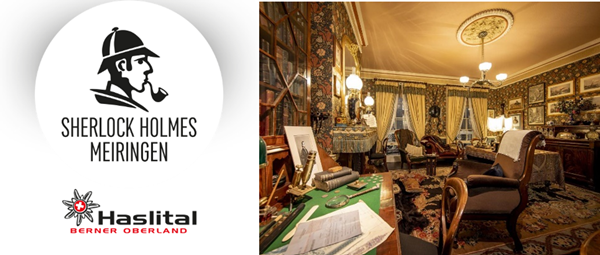
Image: Museum room in the Swiss Alps at Reichenbach Falls for the Sherlock Holmes memory (https://sherlockholmes.ch/en/Welcome)
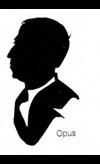
I have used the Holmes silhouette above, but my effigy came about at the Hong Kong meeting. A local artisan with a pair of scissors in his hand, cut my image on white paper in minutes, costing me zero, thanks to David Hillis, the former CEO of the College. And if you look in detail, the artist even managed to preserve the little tuft of hair at my crown, which the barber had missed on my earlier visit.
Now my silhouette has joined the College's collection, telling its own story alongside the portraits lining the walls.
As Paul Klee famously said, a drawing is "simply a line going for a walk". A simple sketch or silhouette can often reveal more of an individual's character than a formal portrait, which may prioritise dignity and convention over personality. Yet, despite their considerable cost, such portraits remain valued and respected traditions.
These College portraits offer little insight into the contributions of the individuals depicted. Yet behind each image lie the characteristics of dedication and talent.