2026 | Volume 27 | Issue 5

Professor Fiona Wood
Professor Fiona Wood is one of Australia’s most honoured and recognised surgeons, but when she was told she would receive the King’s Medal, her first thought was that the message must be spam.
The self-described “card-carrying nerd” spent the weekend wondering whether she was worthy of the honour.
Among her many accolades, Professor Wood has been named Australian of the Year, appointed an Officer of the Order of Australia and received the American Burn Association’s Lifetime Achievement Award.
Yet even with those achievements, Professor Wood’s attention remains on research and what it can make possible, including the questions that remain unanswered for burns patients.
“Have we made a difference, yes. But is there still work to do? Absolutely yes,” she says.
Curiosity becomes a career
Professor Wood entered St Thomas’ Hospital Medical School in London in 1975 and was immediately captivated by anatomy.
She was fascinated by how the body fitted together, how injury changed it and how surgeons could help repair it.
Research gave Professor Wood a place to follow her curiosity and strengthen her CV at a time when many still saw surgery as an unsuitable career for a woman.
“Plenty thought it wasn’t a suitable career for a woman,” she says.
Instead of giving those attitudes her energy, Professor Wood looked for people who believed in her and for opportunities to be useful.
“Engaging in negative energy without output is a waste of oxygen,” she says.
“I went down the research route from the word go. I sought out research opportunities, opportunities to be useful.”
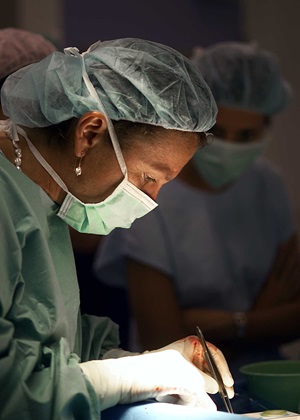
Professor Wood in the operation theatre
From laboratory to bedside
After moving to Australia in 1987, Professor Wood began exploring how cultured skin cells could improve outcomes for burns patients.
Her research focused on speed, to reduce the time to healing, eventually turning a laboratory process that once took weeks into a spray-on skin treatment that could be delivered within minutes.
The work became widely known after she treated survivors of the 2002 Bali bombings, but for Professor Wood, the research journey was far from over.
Her focus remained on what might still be possible.
“My vision has been with me for decades—scarless healing,” she says.
Beyond the burn
Some of her research questions have come directly from patients.
One involved a young boy who survived burns covering 80 per cent of his body but later developed a rare cancer.
Professor Wood wondered whether the cancer might have been linked to the earlier burn injury.
Researchers subsequently linked data from about 34,000 burn patients with 120,000 people who had not experienced burns. That research led to further investigation of the systemic, immune and neurological consequences of burn injury, broadening the question from survival to lifelong recovery.
Her team has established a biobank to understand how the body changes over time after a burn injury.
New technology also allows researchers to combine genetics, phenomics, clinical information and outcomes data in ways previously unavailable, opening new paths for treatment and prevention.
Professor Wood says harnessing that technology requires researchers to collaborate well beyond their own fields.
“What we do is a complex jigsaw,” she says.
“This is more than one individual, more than one specialty. It is an interdisciplinary endeavour.”
For Professor Wood, collaboration is essential if new knowledge is to become care for patients.
“We can do better, we should do better,” she says.
The regenerative goal
Professor Wood’s research now spans five streams: cell biology, skin chemistry, skin repair, systemic responses and neurological impacts.
Her teams are investigating cell therapies, using skin chemistry for prediction and diagnosis, and finding ways to reduce scarring. They are also studying how burns affect the whole person and the neuroimmunolical connection between skin and brain.
Her goal remains scarless healing and regeneration.
“If we can facilitate regeneration, can we do so not just in skin, but in other tissues?” she says.
“That’s the holy grail.”
Professor Wood measures success by what research delivers to patients and their families.
“Success is when we’ve translated something and given a patient a positive, improved outcome,” she says.
“The real guts of this is how we can make a difference to an individual whose life has changed in an instant.”
Professor Wood says surgeons and researchers will need curiosity, courage and the humility to work with others.
“It is a team endeavour, not a solo one.”
Her advice to the next generation is clear.
“Find your own path.”