2026 | Volume 27 | Issue 5

Author: Professor Glendon Farrow OAM FRACS
I only found out by chance that Mr Peter Robert Scott FRCS FRCS(Ed) FRACS FACS had passed away. He was 92 after all, but even though I now live in Sydney I was a little disappointed that such a larger-than-life character, and a seminal part of my surgical education had shuffled off this mortal coil rather unheralded.
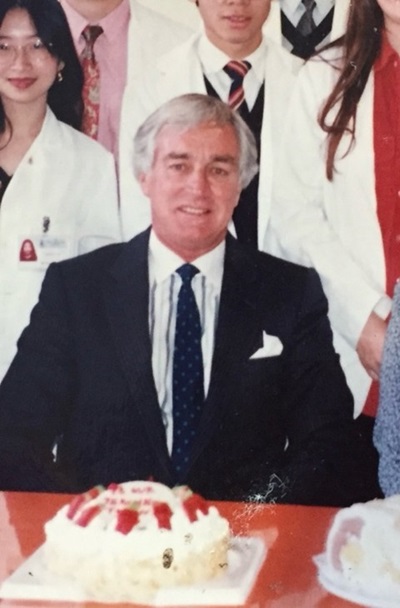
IMAGE CAPTION
“Mr Scott” as we called him—not Peter and definitely not doctor—was the archetypal debonair surgeon, dressed immaculately with unfailing courtesy to those he trusted, and a healthy disrespect of those who perhaps did not meet his standards. He was an outstanding, charismatic and committed teacher whom I was fortunate enough to experience as a medical student, intern and general surgical registrar. Many of his principles I still remember and indeed teach today—‘symptoms, signs, special tests’ being just one of many.
In his youth Mr Scott was a talented Australian Rules footballer, playing centre half forward for Melbourne University Blacks and the Victorian Amateurs team. He also appeared in two games for Hawthorn in 1950 before focusing on his studies. He followed the well-worn path of surgical training at Royal Melbourne Hospital (RMH) and further training overseas before beginning consultant work at 15 Collins Street, Melbourne, where he was based for his entire career. He was a true general surgeon, whose interests evolved from upper gastrointestinal and thyroid surgery to hepatobiliary and breast surgery.
He wasn’t just a consulting room based private practice surgeon either. He was committed to RMH, the public system in general and teaching. He had also led a civilian Royal Melbourne Hospital surgical team to Vietnam in 1965 as part of the South East Asia Treaty Organisation (SEATO).
I recall my first contact with Mr Scott as a fourth-year medical student at RMH in 1981. He arrived for a tutorial dressed in a tan safari suit, matching suntan and gold bracelet, seemingly having just come from somewhere exotic. Mr Scott never attended or just turned up: he arrived. It’s difficult to carry off a safari suit successfully, but Mr Scott did it with ease.
His tutorials were didactic, delivered in a friendly but firm style. He had for many years conducted extremely popular weekly lectures at RMH attended by students from across Melbourne. These lectures became the basis of his highly successful textbook An Aid to Clinical Surgery, first published in 1971 and going on to several editions. The forward by Thomas Ackland states ‘the whole volume consists of concise lucid statements which render it immediately comprehensible and easily referenced’. Other textbooks of the time approached surgery based on disease entities.
His book was deceptively simple, but his approach pre-dated systematic approaches to surgical problems by many years. Today we take the systems approach for granted, especially in trauma. Then, a simplified standardised approach to surgical problems seemed almost non-academic. Indeed, I got the feeling some professorial types looked down their nose at his approach. Each chapter provided the framework for answers to just about any question, whether you knew the answer or not. Even today my students appreciate being given structure in how to answer a question.
I still have my annotated and almost completely underlined, coloured in and highlighted second edition. It proved equally useful as a medical student, intern and registrar, distilling practical information that my Oxford Textbook of Surgery requires two volumes to convey.
His ability to reduce a complex problem to simple principles was demonstrated to me one day in theatre, as I was draping a patient for a thyroidectomy.
“Glen”, he announced loudly on entry from the scrub bay. “Describe the operation of thyroidectomy for me”
“Well, Mr Scott, after prepping and draping the patient, I make a transverse skin crease incision in the neck.”
“No, no, no” he interjected helpfully. “Simon (the theatre orderly), tell Glen about thyroidectomy”
“Yes, Mr Scott. Thyroidectomy is an operation of planes”.
“Correct Simon. Even the theatre orderly knows that Glen”.
This was all said with a good-natured wry smile, but a lesson never forgotten.
I last worked for him as a registrar in 1994, by which time he was close to retirement from RMH and as a true gentleman surgeon, always had wise words of advice for a senior surgical registrar. For example, “always remember the three ‘A’s of surgery, availability, affability and ability, in that order.”
He was quick to adopt the new technique of laparoscopic cholecystectomy late in his career even though it was a steep learning curve. He could see that laparoscopic minimally invasive surgery was the way ahead.
His generation of general surgeons bridged the gap between returned WWII surgeons such as Weary Dunlop and Tom Ackland who still roamed the RMH corridors when I was a student, to today’s more technical specialist surgeons. The ability to think on your feet, make a clear decision and move on, was learnt by necessity by his mentors and then passed on to his generation. Now, in a complex world of new non-invasive techniques and super specialisation, his style was more akin to today’s trauma and emergency surgery.
My last contact with him was in 2020, having sent him a copy of a small book I had written on patient safety and had sent copies to my surgical supervisors as a way of saying thank you. I received a handwritten note thanking me and urging me to keep up the good work. At age 89 he’d remembered me and taken the trouble to write. An old-fashioned courteous generation that is sorely missed.
Peter Scott’s major contribution to surgery was in education—a tradition many carry on today, but I suspect without the style, flair and enthusiasm he exhibited.
He had several quirky mannerisms, but I always remember the sharp intake of air between clenched teeth when, on reviewing a patient not doing well in ICU after a major gastric reduction he pronounced, “Those are the risks of surgery”.
Vale Peter Robert Scott (24 March 1931 – 15 May 2023)