2026 | Volume 27 | Issue 5

Prof Roy Kimble
Author: Professor Roy Kimble, FRACS
Since 2023, a paediatric surgical team from Queensland Children’s Hospital (QCH) has undertaken six surgical deployments to Timor-Leste in partnership with the Royal Australasian College of Surgeons (RACS) Global Health, with funding support from the Children First Foundation.
These Visiting Medical Teams (VMTs) have been led by Professor Roy Kimble, Director of Paediatric Surgery, Burns & Trauma at QCH. The small team comprises of paediatric surgeons, anaesthetists, theatre nurses, stomal nurses and, in 2026, a research assistant. The team of four to six clinicians works alongside local staff at Guido Valadares National Hospital in Dili, Timor-Leste. Through training and education, it aims to build local capability while providing crucial paediatric surgical support.
The most recent two-week VMT deployment, in July 2026, involved consultations with 115 children in clinic and on the wards. The team also made 54 trips to theatre involving 48 children, ranging from newborns to 17 years.
The principal focus of these VMTs is the treatment of anorectal malformations (ARM) and Hirschsprung disease (HD). Timor-Leste has a population of more than 1.4 million people. It has a very young population, with a median age of approximately 21 years, and one of the highest birth rates in the world.
Both ARM and HD occur in approximately 1 in 5000 births. Children with these conditions usually require a colostomy during the neonatal period to survive. Local general surgeons are highly capable of performing these life-saving procedures. However, they have historically had limited opportunities for training in the definitive procedures required to subsequently restore bowel continuity and close the colostomy.
Colostomy bags are not readily available to the local population. As a result, many children have grown up using pieces of cloth to cover their stoma. The resulting odour and attraction of flies can lead to significant social stigma. Children may be unable to swim, play with their peers or attend school, while families can be forced to live on the outskirts of their villages.
During our outreach work, we identified more than 100 children living in these circumstances, with more continuing to be born each year. Fortunately, most of these children have now undergone definitive surgery and had their stomas closed. Importantly, most have no significant co-morbidities and are subsequently able to integrate into normal childhood and community life.
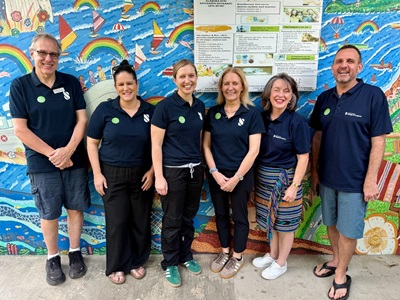
l to r: Prof Roy Kimble, Joelene Steel, Dr Aimee Gibson, Kath Hazell, Dianne Greathead, and Dr Dean Bunbury
Research into bowel function and continence
During the most recent VMT deployment, two important research projects began.
The first arose from an observation made by the visiting team: most Timorese children who have completed their surgery appear to have excellent bowel continence. This contrasts with the experience of many children in Australia with the same conditions, who may continue to experience long-term bowel dysfunction, including constipation, faecal incontinence and soiling. These problems can persist into adolescence and adulthood and have a significant impact on health-related quality of life.
One possible explanation is dietary. The Timorese diet is generally high in fibre and low in processed foods. Timor-Leste uses the US dollar, and a substantial proportion of the population lives on very limited incomes. Families therefore commonly rely on vegetables and fruit grown in their gardens or purchased in local markets, while imported processed foods are unaffordable for many.
Diet is known to play an important role in bowel health in the general population and is routinely incorporated into bowel-management programs for children with HD and ARM. However, there is limited evidence comparing dietary patterns and their association with continence outcomes across different cultural and healthcare settings.
The first study, therefore, aims to compare bowel continence outcomes and dietary patterns among children who have undergone corrective surgery for HD or ARM in Queensland and Timor-Leste.
By identifying factors associated with improved bowel function across these two distinct populations, the study may help to inform culturally appropriate bowel-management strategies and contribute to optimising long-term continence outcomes for children living with these conditions.
Research into postoperative pain
The second research project arose from another observation made by the VMTs: children in Timor-Leste appeared to require less postoperative analgesia than their counterparts in Australia.
Postoperative pain is one of the most common and significant complications experienced by children undergoing surgery. Poorly controlled pain can delay recovery, increase anxiety and distress, prolong hospitalisation and negatively affect both short- and long-term health outcomes.
Although advances in pain assessment and multimodal analgesia have improved postoperative pain management, considerable variation remains in the pain experience and analgesic requirements of individual children.
Pain is a complex biopsychosocial experience influenced not only by the type of surgery and the underlying medical condition, but also by psychological, environmental and cultural factors. Family presence and parental behaviours can influence how children perceive, express and cope with pain. Cultural beliefs surrounding pain, communication and caregiving may also influence pain reporting, parental responses and analgesic use. These factors, however, have received relatively little attention in paediatric surgical populations.
Timor-Leste and Australia provide distinctly different healthcare, cultural and socioeconomic environments, creating a unique opportunity to explore how these factors may influence children's postoperative pain experiences.
During the VMT deployment, postoperative pain scores were recorded alongside analgesic requirements. Interactions within the family unit were also documented in both settings.
Looking forward
Together, these two research projects provide an opportunity to explore how children with similar surgical conditions experience very different healthcare, socioeconomic, dietary and cultural environments.
By comparing outcomes between Timor-Leste and Australia, we hope to identify factors that may contribute to differences in bowel continence and postoperative pain. Importantly, the aim is not simply to describe these differences, but to understand what may be contributing to them.
Ultimately, this work may enable us to adapt aspects of the management of children with ARM and HD, with the potential to improve long-term outcomes for children in both Timor-Leste and Australia.