2026 | Volume 27 | Issue 2
Author: Associate Professor Felix Behan, AM
I have taken a leaf out of Agatha Christie’s novels, of which she has authored many, and Poirot and his exploits keep emerging. She became the Queen of Crime and one of the greatest novelists of the 20th century.
Since my last dissertation in Surgical News on Livingstone (Opus 97) more interesting anecdotes have emerged, which warrant some inclusion in any Livingstone text.
Professor Wayne Morrison told me there is a Livingstone gene on his family side, “Livingstone’s maternal grandmother was a Morrison and she is a forebear of my father, hence my name Morrison.”
Even Professor Tom Robbins, a plastic surgical graduate from Canniesburn gave his penny’s worth when he remarked that he once saw a notice during his training there that a Dr Hubert Wilson, identified as the grandson of the great David Livingstone, would be presenting a lecture at some future date, no doubt about historical recollections. Even Livingstone’s field diaries went to the National Library of Scotland.
Following my initial Livingstone story more facts kept erupting, which I would have liked to have included but space was a constraint, hence the sequel. So, this dissertation has given me some leeway adding to the narrative of the London Missionary Society. They invited Livingstone to go to Africa to find the source of the Nile and fortuitously he found Victoria Falls.
And the modern world today could well do with a little touch of recounting history and well phrased by the philosopher George Santayana in 1905 in his work ‘The Life of Reason’. Even Cicero has his version of events when he said "To be ignorant of what occurred before you were born is to remain always a child" – crisp as ever.
From the Antiques Roadshow recently—my source of historical recollections with a little touch of the collector’s bent of which I am guilty—some Livingstone family archives were shown to have made their way back to England. These included photographs of Livingstone and his native contingent, along with his wrapped, embalmed body carried in a cylinder made from the bark of a Mpundu tree.
This bark cylinder was then wrapped in sailcloth to protect it during the thousand-mile trek across Africa to the closest British consulate at Bagamoyo to facilitate the transport of his body to Westminster Abbey to join the regal fraternity there.
His native companions buried his heart under that Mpundu tree saying, “His heart belonged to Africa”, with the native pall bearer Jacob Wainwright inscribing the tree with the words 'Livingstone May 4, 1873’ on to the tree bark (illustrated).
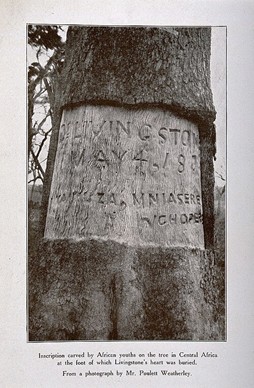
Tree with inscription
Wainwright, a freed slave who was the only African pallbearer at Livingstone's funeral in Westminster Abbey, is frequently mentioned in segments regarding these relics.
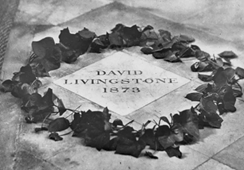
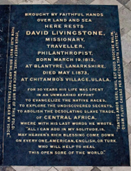
The original stone site and David Livingstone's grave in Westminster Abbey
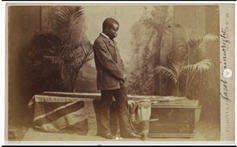
Jacob Wainwright with Livingstone's coffin
Incidentally, in my first surgical year as a Trainee in surgery at the Royal Brisbane Hospital, I came under the care of Dr Bob Wainwright, a later plastic and reconstructive surgeon, with whom I had a firm association. How coincidental that the same name surfaced during these Livingstone recollections. Bob showed me how to do my first intravenous IV canular which I cannot forget.
A chance conversation, sparked during a GP visit and linked to Professor Ian Hayes’ experience, led me down a path of historical reflection and reminded me of the importance of learning from the past.
When Livingstone was 19, he had saved enough money to begin medical training at Anderson’s college in Glasgow. His medical practice was remarkably varied, ranging from obstetrics, ophthalmology, tumours and tuberculosis, and even venereal disease—a problem in those days.
It is a well-known fact that graduates from the Scottish schools of medicine and surgery were of the highest quality and Livingstone was one such product.
My late friend Professor Gordon Clunie became Professor of Surgery at the Royal Melbourne Hospital and was also a product of that Scottish medical school training and a firm disciplinarian. Another trait evident with Professor Tom Robbins who emigrated to Australia and after becoming a bricklayer’s assistant, graduated in medicine locally and became Professor John Hueston’s private assistant, the leading plastic surgeon at the time—not bad—and established the Robbins technique for breast reduction, later adopted by Professor Jan Olof Strömbeck, a world figure. The Scottish genes keep surfacing.
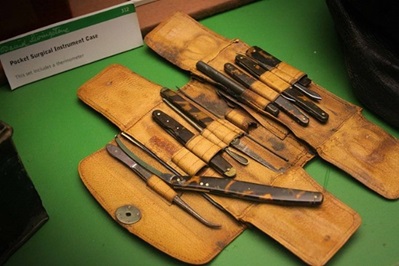
Livingstone's pocket surgical instrument case
It is interesting that Livingstone, with his astute medical insight, recognised the value of quinine in treating malaria. This followed the Jesuit contribution in the 1620s, when cinchona bark from South America was identified as an effective treatment. Even today, that legacy endures—every time I buy tonic water, I’m reminded that Schweppes originally sweetened the bitter cinchona medicine, giving rise to the gin and tonic now enjoyed around the world.