2026 | Volume 27 | Issue 2
Author: Dr Peter F Burke, FRCS FRACS DHMSA, Specialty Editor-Surgical History: ANZ Journal of Surgery
My interest in medical history was sparked by a series of voluntary lectures delivered at the University of Melbourne MBBS course during the 1960s. Professor Kenneth ‘Red’ Russell who held dual chairs in anatomy and medical history at the university, delivered information that provided background and substance to persons eponymously referred to in our anatomical studies. Who was Hunter of Hunter’s Canal? Why, John Hunter, surgeon, born at Long Calderwood, East Kilbride, Scotland—and here, an image of his home!
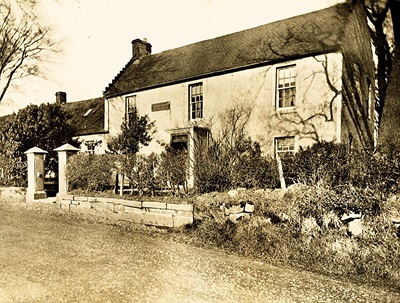
John Hunter's home
In the early 1970s when working as an Anatomy Demonstrator at the University of Melbourne Medical School, there was the marvellous opportunity to initiate and develop a lifelong friendship with the very same Kenneth Russell.
As a Graduate Research Fellow at St Vincent’s Hospital Melbourne, a year spent undertaking microsurgical research with Mr Bernard O’Brien, also proved most fortuitous. Some years later O’Brien delivered a lecture on Abraham Colles and His Australian Connection astonishing me with the depth and clarity of research and the way this material was presented—formative influences for the young student of history.
Post FRACS, I travelled the route so often taken by newly minted Fellows to England. There, I secured the Fellowship of the Royal College of Surgeons of England, a qualification that appeared to reassure my English surgical hosts of my competence.
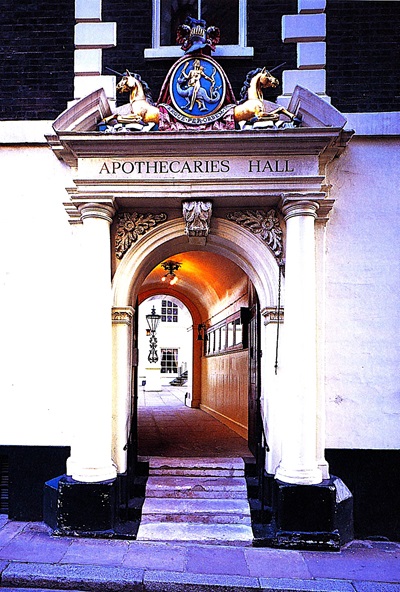
Apothecaries Hall, Black Friars Lane
It was now with the post-nominal ‘window dressings’ out of the way, I had time to pursue and develop a deeper interest in medical history, but how? A discussion with my houseman from Barts, disclosed the Society of Apothecaries’ Diploma Course in the History of Medicine, a previously unknown entity. Instituted in 1970 by the Worshipful Society of Apothecaries of London, this course provided admission to the examination for the Diploma in the History of Medicine of the Society.
Requisite fees were paid with alacrity: in autumn 1977 I commenced an astonishingly wide-ranging study into all aspects of medical history. The reading list ‘for reference’ comprised no less than 174 books, on topics ranging between Renaissance and Before and Social Medicine. From that list, over time, I have established a personal reference library of general histories, specific histories and biographies.
The formal course comprised lectures and presentations conducted on a fortnightly basis at the Westminster Hospital in Horseferry Road SW1. The most eminent lecturers in all prescribed fields featured and site visits included the Chelsea Physic Garden and the old operating theatre at St Thomas’ Hospital.
The regulations for the diploma examination stipulated that it contain five sections, one comprising two three-hour written papers, undertaken on the same day. An essay of no less than 3000 and no more than 5000 words to be written in the candidate’s own time, using all available library resources and to be fully documented with references and bibliography. A test lesson or lecture, for which the candidate was allotted a subject one month in advance, and an oral examination, based on the essay submitted, in which the candidate’s familiarity with historical sources was to be tested.
The examination was conducted at various sites in London and subsequently came the post-nominal DHMSA, which also preceded election as a Fellow of the Royal Society of Medicine, in the field of medical history. Thus, was completed my formal examinations attesting to knowledge of matters medical historical. From that time began the more informal and self-prescribed mode of acquiring such knowledge.
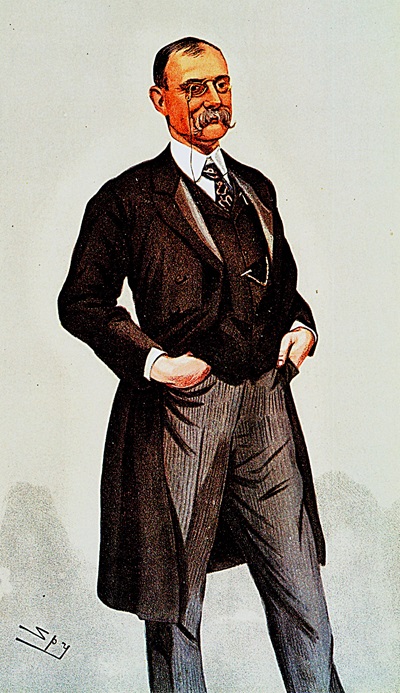
'Freddie': Sir Frederick Treves 'Spy' caricature
One day in 1977 my wife presented me with a magnificent lithograph, the portrait of a very dapper Victorian gentleman. The portrait’s caption simply read ‘Freddie’, my wife noting that her acquisition had been prompted by the vendor’s comment, “He’s a doctor!”
This, in turn, led me to developing my ability to examine and document such objects—a process which has evolved and matured over the many subsequent years, providing much joy and many discoveries, in turn leading to many a written word.
The portrait was identified as a caricature of Sir Frederick Treves, surgeon and author, painted by Sir Leslie Ward, better known by his nom de plume, ’Spy’. Such caricatures had ensured the success of Vanity Fair magazine, which was published weekly from 1868 to 1914. Over time more than 100 persons of medicine and science were featured thus: pari passu, a very rich stream of interest, with many tributaries, commenced to flow.
On my return to Australia in 1979, Bernard O’Brien introduced me to Sir Douglas Miller, then RACS Archivist and former College president. A two-hour interview in the College Library, overlooking Spring Street, produced an invitation to join the RACS Archives committee. Of all the many RACS committee appointments I have served subsequently, none has proven more enjoyable or more instructive.
Around the table in the Hailes Room at the College, we members invariably occupying the same seats, hours were spent by the Archives Committee, inter alia, plotting how College Council could be convinced of the importance of College archives.
Bernard O’Brien, our man on Council, was always cross-examined by committee members on the success or otherwise of his representations on our behalf. The committee’s submissions to Council were well prepared and finally persistence paid off, resulting in the appointment of the very first college archivist, Thomas ‘Tam’ Best. His work immediately led to the retrieval and preservation of unique records such as the Minutes of the College AGMs 1928-1937, which were in a parlous state
I was a participant in the first ever RACS Younger Fellows course in Wellington, New Zealand, which immediately followed the 1982 Christchurch General Scientific Meeting (GSM), precursor to today’s ASC. This was a fully immersive, live-in experience with other Younger Fellows: very close, and lasting, associations were formed with the designated councillors, Bennett, Beasley and Mellick.
Being elected spokesperson for the group I prepared detailed position and review statements for Council’s consideration. At the suggestion of Sam Mellick I was requested by John Clarebrough PRACS, to share a joke in the Wellington Clinical School lecture theatre, with all attendees gathered; as a result, the group became known as ‘The Liontamers ‘.
A RACS Foundation Travelling Fellowship to Germany, France, and the United States followed, in the study of trauma care. This, in turn, provided material for my first editorial for the ANZ Journal of Surgery, ‘Trauma Centres’, in 1986.
Living and working in Gippsland led to significant involvement with the Provincial Surgeons of Australia (PSA) and their extraordinarily practical clinical conferences, even including my translating the PSA motto into Latin. After many years’ service as the Australian Medical Association (AMA) Gippsland, Victorian State Council representative, I was appointed a Fellow of the AMA in 2012.
I have served on most RACS committees, culminating in my appointment by Council to the role of Honorary Principal Curator. In 2008 I was appointed Specialty Editor-Surgical History for the Australian and New Zealand Journal of Surgery, a position, which I retain. I have delivered many major lectures including the Archibald Watson, Herbert Moran and Kenneth F Russell Memorial lectures—more recently serving as the Distinguished Invited Lecturer at the 2022 Brisbane ASC.
The years prior to my retirement from active surgical practice were a period of gradual transition, including much writing in medico-legal matters—finally retiring from any form of clinical practice at 78 years of age.
Forever the student of history I continue to enthusiastically serve the College in matters archival, editorial, and heritage and have recently published a collection of some of my articles for Surgical News, under the title, From Harrods to Hackney: A Surgical Miscellany.
I instilled in my medical students the idea of ‘creating one’s own medical history’, through clinical work, observations and retention of appropriate records, particularly correspondence; combined with participation in continuing medical education and the utility and pleasure of collegiate Fellowship, as I have always sought over time.